

The Assumption Most People Start With
If you ask someone to imagine a farm, they’ll almost always picture the same thing.
Wide open land.
Trees/saplings spaced generously apart.
Time moving slowly.
And in that image, there’s a quiet belief:
👉 More land means more output.
It feels intuitive. It feels right.
And for decades, it was.
But here’s the uncomfortable truth:
Traditional farming wasn’t designed for efficiency. It was designed for survival.
And once you understand that, the comparison between traditional farming vs high-density farming stops being technical…
…and starts becoming fundamental.
What Traditional Farming Actually Looks Like
Traditional farming in India has been shaped by generations of practice, not optimization.
It prioritizes:
- Lower input costs
- Natural spacing
- Long-term tree growth
In crops like mango, this translates to:
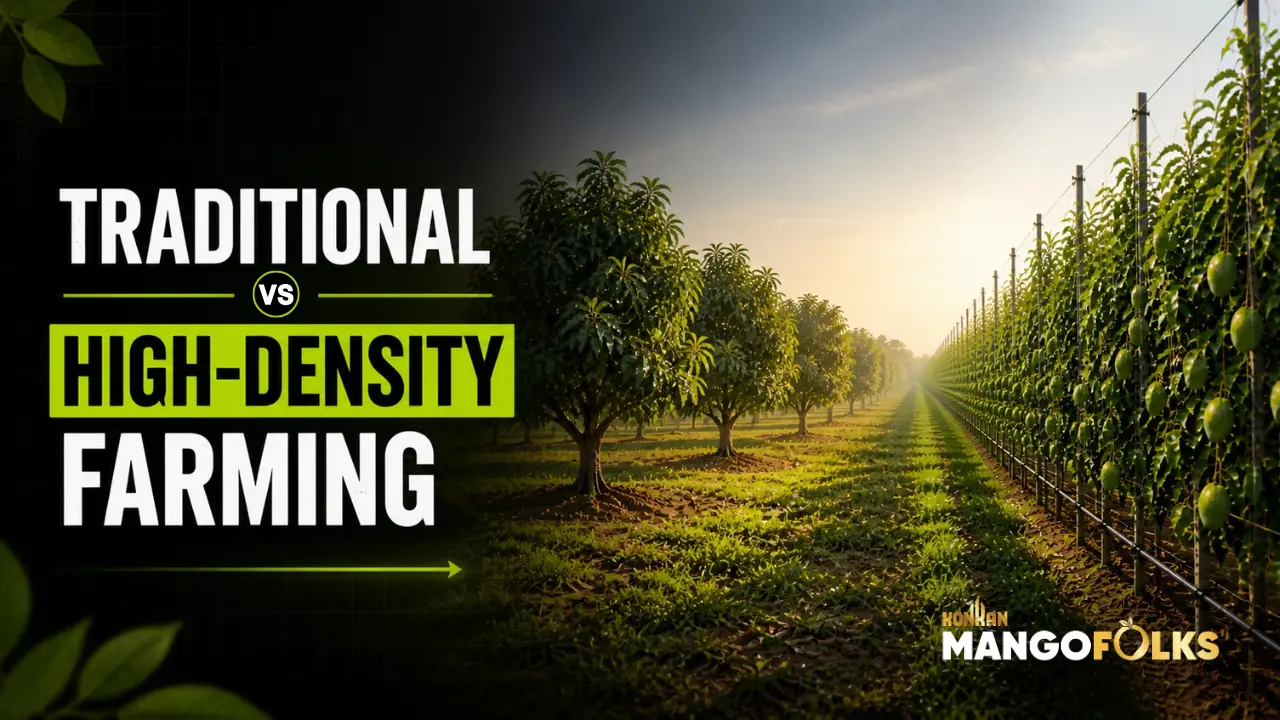
- Around 30–40 trees per acre
- Large canopies
- Irregular yield cycles
There’s a certain beauty to it. A sense of patience. But economically, it comes with limitations.
Yield per acre is restricted—not because the land cannot produce more, but because the system isn’t designed to extract more from it.
Which is why, when people explore mango farming profitability in India, traditional methods often fall short of expectations.
What is High-Density Farming (UHDP)?
Now imagine the same acre of land—but used differently.
Instead of spacing trees far apart, you plant more.
But you control their growth.
You prune regularly.
You manage canopy size.
You regulate sunlight and airflow.
This is high-density farming, and in mango cultivation, it is often referred to as UHDP farming (Ultra High Density Plantation).
The shift is simple—but powerful:
- From 40 trees per acre → 300–400 trees per acre
- From uncontrolled growth → managed structure
- From natural yield → engineered yield
This is not just a farming technique.
It’s a system designed for efficiency, predictability, and scale.
The Core Difference Isn’t What You Think
Most people assume the difference is about number of trees.
It’s not.
It’s about control.
Traditional farming allows trees to grow as they naturally would.
High-density farming controls:
- Tree height
- Canopy spread
- Nutrient intake
- Growth cycles
Which leads to something important:
👉 Uniformity
And uniformity in agriculture is powerful.
Because once output becomes predictable,
it becomes measurable.
And once it becomes measurable,
it becomes investable.
Yield, Efficiency, and Economics — A Real Comparison
Let’s ground this in reality.
Not theory.
Traditional Mango Farming (1 Acre, Mature Stage)
- Trees: ~35–40
- Yield per tree: 80–100 kg
- Total yield: ~3,500 kg
UHDP Mango Farming (1 Acre, Mature Stage)
- Trees: ~350
- Yield per tree: 20–25 kg
- Total yield: ~7,000–10,000 kg
At first glance, it seems counterintuitive.
Smaller trees, less yield per tree—yet higher total output.
That’s the essence of high-density farming in India:
👉 Less reliance on individual trees
👉 More reliance on system efficiency
Now consider pricing.
Even at a conservative ₹60–₹80 per kg,
the difference in annual revenue becomes significant.
Which is why discussions around agriculture investment returns in India increasingly include high-density models.
Why High-Density Farming Changes ROI
Returns in agriculture don’t just depend on what you grow.
They depend on:
- How efficiently you grow
- How consistently you produce
- How early the system starts yielding
Here’s where UHDP changes the game:
1. Faster Yield Onset
Traditional orchards take longer to stabilize.
High-density systems begin producing earlier.
2. Higher Yield Per Acre
Not because the land changes—but because utilization improves.
3. Better Quality Control
Uniform trees lead to:
- More consistent fruit size
- Better grading
- Higher market value
4. Easier Management (Paradoxically)
Controlled tree size makes:
- Harvesting easier
- Maintenance more systematic
All of this directly impacts ROI in mango farming India.
The Hidden Trade-Offs Nobody Talks About
Now let’s step away from the pitch.
Because no system is perfect.
Higher Initial Investment
High-density farming requires:
- Better planning
- Irrigation systems
- Scientific inputs
Dependency on Management
Traditional farming tolerates inconsistency.
UHDP does not.
Poor management can:
- Reduce yield
- Affect plant health
- Disrupt the system
Learning Curve
It’s not intuitive.
You need:
- Knowledge
- Monitoring
- Discipline
👉 In short:
High-density farming is powerful—but unforgiving.
Which One Is Better (And For Whom)?
This is where nuance matters.
Traditional Farming Works Well When:
- You have generational experience
- Labor is available
- You prioritize low input cost
- You are not focused on maximizing ROI
High-Density Farming Works Better When:
- You want higher productivity per acre
- You are thinking in terms of investment returns
- You rely on structured management systems
- You want predictability and scalability
👉 So the real question is not:
“Which is better?”
It’s:
👉 What are you optimizing for?
Where Modern Farmland Investment is Moving
If you look closely, the shift is already happening.
Investors are no longer just asking:
- “Where should I buy land?”
They’re asking:
- “How is that land being used?”
- “What system is driving returns?”
And increasingly, the answer points toward:
- Managed farming
- Scientific methods
- High-density plantation systems
Because when agriculture moves from:
👉 activity → system
It becomes something new.
Not just farming.
But an investable, structured asset class.
A Quiet Shift Worth Noticing
This is where certain platforms are positioning themselves differently.
Not by selling land alone—but by designing the system around it.
For example, Mangofolks by Konkan Estate focuses specifically on:
- Managed mango orchards
- UHDP farming systems
- Transparent yield tracking
- Structured ownership models
Which, if you think about it, addresses the exact gap between traditional farming and modern investment thinking.
Not as a replacement for farming.
But as an evolution of it.
Key Takeaways
- Traditional farming prioritizes stability; high-density farming prioritizes efficiency
- UHDP farming significantly increases yield per acre
- ROI improves when farming becomes system-driven
- High-density models require better management and discipline
- The future of agriculture is moving toward structured, scalable systems
Traditional farming uses wider spacing and natural tree growth, while high-density farming uses more plants per acre with controlled canopy management to increase yield and efficiency.
For productivity and return on investment, UHDP farming generally performs better. However, it requires more precise management and higher initial setup investment.
UHDP (Ultra High Density Plantation) mango farming is a method where 300–400 trees are planted per acre with controlled canopy growth and scientific management practices.
High-density farming typically delivers better returns due to higher yield per acre, improved efficiency, and more consistent produce quality.
Yes, especially when supported by professional farm management systems that handle operations, monitoring, and maintenance.
Closing Thought
The difference between traditional and high-density farming isn’t just about technique.
It’s about intent.
One is rooted in continuity—
the other in optimization.
And as agriculture slowly shifts from livelihood to investment,
that difference begins to matter more than ever.
Because in the end, it’s not just about growing crops.
It’s about how intelligently you use the land beneath them.