


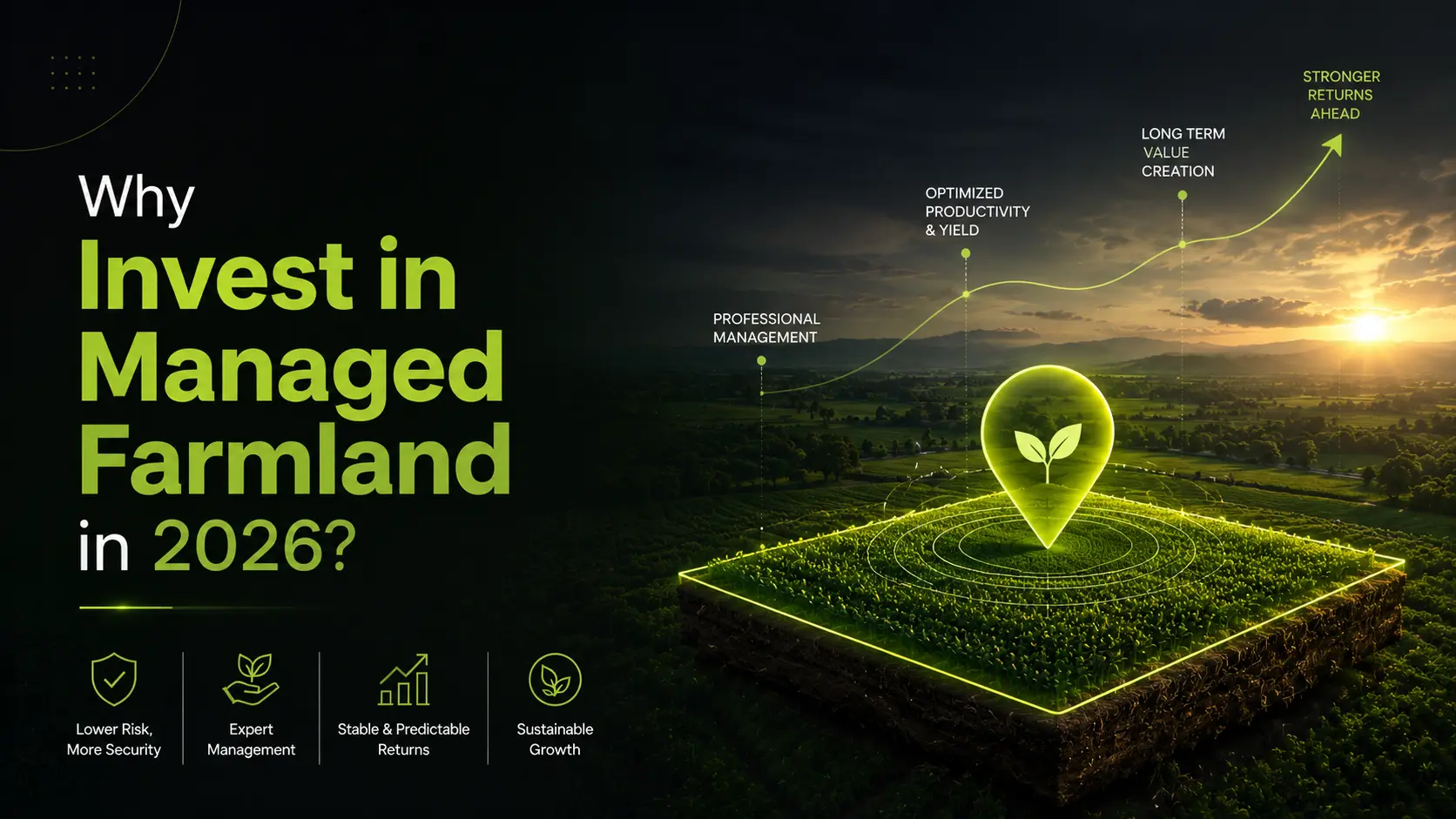
Something About Modern Wealth Feels Increasingly Fragile
There’s a strange anxiety built into modern investing.
You can see it in the way people check markets compulsively.
In how quickly trends rise and collapse.
In the quiet exhaustion many people feel after years of chasing speed, growth, and volatility.
A lot of modern wealth feels… intangible.
Numbers on screens.
Dashboards.
Apps.
Charts moving in directions nobody fully understands.
And somewhere inside all that noise, more people are beginning to ask a quieter question:
👉 What actually feels real anymore?
That question is one of the reasons managed farmland investment in India is attracting attention in 2026… not as a trend, but as a reaction.
A reaction to overstimulation.
To over-financialization.
To the growing desire for assets that feel grounded, understandable, and connected to something tangible.
What Managed Farmland Actually Means
Before we go deeper, let’s simplify the term itself.
Managed farmland in 2026 refers to agricultural land that is professionally operated and maintained on behalf of owners.
In most structured models:
- The land is cultivated by experienced teams
- Farming operations are handled professionally
- Owners are not expected to actively farm themselves
The appeal lies in the combination of:
- Land-backed ownership
- Structured agricultural management
- Long-term ecosystem thinking
This is why terms like:
- managed farming India
- farmland ownership
- managed orchards
- agriculture-backed assets
are becoming increasingly relevant in modern conversations around alternative assets.
But the real story is bigger than operations.
It’s psychological.
Why Interest in Farmland Is Growing Again
For decades, farmland sat outside the aspirational investment conversation.
People discussed:
- apartments,
- stocks,
- startups,
- commercial real estate.
Agriculture felt old-world. Slow. Traditional.
And then something shifted.
Not suddenly. Quietly.
People began realizing that:
- digital abundance doesn’t always create emotional security,
- fast-moving assets often create stress instead of peace,
- and hyper-urban life leaves many people disconnected from anything tangible.
At the same time:
- sustainability became economically relevant,
- food systems became more important globally,
- and climate conversations began influencing long-term thinking.
Which is why farmland investment in India is no longer viewed only through an agricultural lens.
It’s increasingly being viewed through the lens of:
- permanence,
- resilience,
- and meaningful ownership.
The Shift From Ownership to Managed Ownership
But there’s an important distinction here.
Most people are not trying to become farmers.
They are trying to participate in:
- land ownership,
- agricultural ecosystems,
- and long-term nature-connected assets,
without needing to personally manage farming operations.
That distinction changes everything.
Because traditional farmland ownership comes with complexity:
- labor management,
- irrigation,
- crop planning,
- maintenance,
- monitoring.
And for urban professionals, entrepreneurs, and globally mobile individuals, that complexity becomes impractical.
This is where managed farmland models enter the picture.
They separate:
👉 ownership
from
👉 operations.
And that separation is what makes the category accessible to a completely different audience.
Why 2026 Feels Different
Every few years, the emotional mood around investing changes.
2026 feels less obsessed with aggressive growth and more interested in:
- stability,
- intentionality,
- and long-term alignment.
People are becoming more selective about:
- what they own,
- why they own it,
- and whether it actually adds meaning to their lives.
That’s important.
Because managed farmland isn’t appealing purely because of agriculture.
It’s appealing because it intersects multiple modern desires simultaneously:
It feels tangible.
You can visit it. Walk through it. Experience it physically.
It feels slower.
Not in a negative way, but in a grounding way.
It feels connected to reality.
Food, land, seasons, ecosystems.
And increasingly, it feels future-aligned.
Especially when combined with:
- scientific farming systems,
- sustainable practices,
- and structured management.
The Emotional Psychology Behind Land Ownership
This part rarely gets discussed properly.
People don’t just buy land because they expect value appreciation.
They buy land because land represents something emotionally ancient:
- permanence,
- continuity,
- rootedness.
There’s a reason physical land feels psychologically different from digital assets.
Land exists independently of market sentiment.
It does not disappear because an app changes.
It does not become irrelevant because a trend shifts.
And in an era where so much of life feels temporary, that matters more than many people realize.
What Makes Managed Farmland Appealing Today
The strongest managed farmland models today are not selling “farming.”
They are creating:
- structured ownership experiences,
- professionally maintained ecosystems,
- and low-friction participation in agricultural land.
And increasingly, they combine:
- modern agricultural techniques,
- transparent management systems,
- and long-term sustainability thinking.
For many people, that combination feels uniquely compelling because it sits between:
- lifestyle,
- land ownership,
- and future-focused investing.
Not aggressively financial.
Not purely emotional.
Something more balanced.
What Smart Buyers Are Paying Attention To
The conversation around managed farmland is becoming more sophisticated.
People are asking better questions now.
Not:
👉 “How quickly will this grow?”
But:
- Who manages the land?
- How transparent is the structure?
- Is the agricultural model sustainable?
- Is the ownership framework clear?
- Is the ecosystem designed thoughtfully?
And honestly, those are healthier questions.
Because in land-backed assets, systems matter more than hype.
A Simple Framework to Evaluate Managed Farmland
Before considering any managed farmland opportunity, it helps to evaluate four things:
1. Land Legitimacy
Clear ownership structure and proper documentation.
2. Operational Quality
Who is actually managing cultivation?
3. Transparency
Reporting, visibility, communication.
4. Long-Term Alignment
Is the model built for sustainability, or short-term excitement?
This framework alone eliminates a surprising number of weak models.
The Risks People Should Still Understand
Let’s stay grounded.
Managed farmland is not a magical category.
Like any real-world asset, it comes with variables:
- climate conditions,
- operational quality,
- biological unpredictability,
- long-term time horizons.
Which is why the strongest buyers approach it thoughtfully, not emotionally.
The goal is not fantasy.
The goal is alignment:
- with your mindset,
- your timeline,
- and the kind of ownership experience you actually value.
Where Modern Managed Farming Models Are Evolving
One of the more interesting shifts happening right now is that certain platforms are beginning to combine:
- land ownership,
- scientific agriculture,
- and structured operational ecosystems.
Not as speculative narratives.
But as thoughtfully designed systems.
This is where models like Mangofolks by Konkan Estate become interesting to observe.
Not because they position themselves aggressively as investment products, but because they reflect the broader evolution of the category itself.
Their focus on:
- managed mango orchards,
- scientifically structured methods like UHDP farming,
- operational transparency,
- and long-term agricultural ecosystems,
aligns closely with what modern buyers increasingly care about:
👉 meaningful ownership without operational chaos.
And that distinction matters.
Key Takeaways
- Managed farmland combines land ownership with professional agricultural management
- Interest in farmland is increasingly tied to emotional and lifestyle psychology, not just finance
- 2026 is seeing a broader shift toward tangible, grounded assets
- The strongest models prioritize transparency, structure, and sustainability
- Managed farmland appeals to people seeking long-term, meaningful ownership experiences
Managed farmland refers to agricultural land professionally maintained and operated on behalf of owners. Learn more about managed farmland.
Many people are seeking more tangible, long-term, and grounded assets compared to purely digital or speculative investments. Explore farmland investment opportunities.
No. Managed farmland separates ownership from daily farming operations through professional management systems.
Its combination of land-backed ownership, sustainability, structured management, and long-term ecosystem thinking makes managed farmland attractive today.
Buyers should evaluate land legitimacy, operational transparency, management quality, and long-term sustainability alignment before exploring managed farmland opportunities.
Closing Thought
The future of ownership may not belong entirely to things that move the fastest.
In fact, some of the most meaningful assets in the coming decade may be the ones that feel:
- slower,
- more tangible,
- and more connected to reality.
Managed farmland sits quietly in that space.
Not demanding attention.
Not promising fantasy.
Just offering something increasingly rare in modern life:
👉 the feeling that what you own is rooted in something real.