

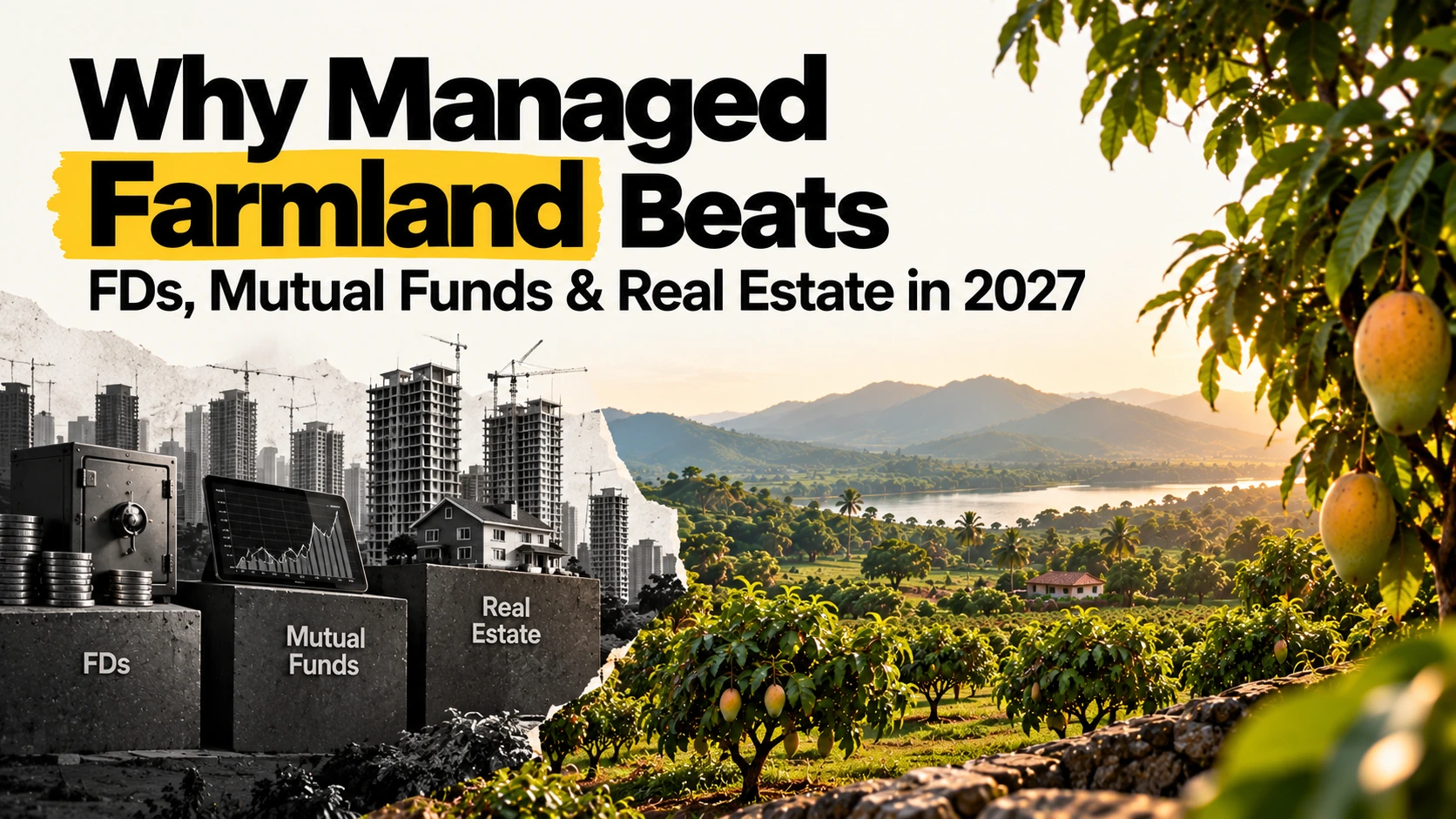
You can put your money in an FD and know exactly what kind of financial product you are holding.
You can invest through mutual funds and let professional fund managers handle the portfolio.
You can buy an apartment, rent it out and build your real estate portfolio.
Or you can own something that does something surprisingly simple: it produces.
That is where managed farmland becomes interesting.
For years, farmland has largely been associated with farmers, inherited family property or people willing to spend their mornings worrying about irrigation, labour, crops and harvests.
But there is another way to look at it.
Imagine a professional living in Mumbai who wants to own land, likes the idea of agriculture and would love to have a productive asset outside the city, but has neither the time nor the expertise to run a farm.
That person does not necessarily need to choose between a corporate career and agricultural ownership.
Managed farmland bridges that gap.
You can own a tangible agricultural asset, have it put to productive use, participate in the potential income generated by the farm and have professionals handle the day-to-day agricultural operations.
Add the possibility of family use, a weekend escape and future lifestyle opportunities, and the proposition becomes considerably more interesting.
This is why managed farmland near Mumbai and Pune deserves serious attention in 2027.
Not simply as another place to put your money, but as a different kind of asset altogether.
What Is Managed Farmland?
Let’s start with the simplest definition.
Managed farmland is agricultural land where professional agricultural teams take responsibility for farming and orchard-management activities while the investor remains the landowner according to the project’s ownership structure.
Depending on the project, management can involve plantation, irrigation, orchard maintenance, agricultural monitoring, labour coordination, harvesting and produce-sales management.
The distinction between owning farmland and managing a farm is important.
Suppose you purchase agricultural land independently.
You may own the property, but you still have to figure out what happens next.
What should be cultivated?
Who manages irrigation?
Who looks after the trees?
Who coordinates labour?
Who handles harvesting?
Who sells the produce?
For someone living and working in Mumbai, these responsibilities can quickly turn a weekend dream into a second profession.
A managed farming model changes the equation.
The owner owns the land, while an expert agronomist takes care of the farming operations covered under the arrangement.
This creates a much more accessible route into agricultural ownership for people who appreciate the value of farmland but do not want to become farmers themselves.
Why Productive Assets Are Different
There is a fundamental difference between owning an asset and owning an asset that is actively producing.
A vacant plot is land.
A mango orchard is land and an agricultural enterprise taking place on that land.
That distinction matters.
Trees grow. Crops develop. Fruit is harvested. Produce enters the market.
When agricultural land is professionally managed, the investor is not simply holding a piece of earth and waiting for something to happen.
The land has a purpose.
It is being used.
It can potentially produce agricultural output and create an income opportunity through the sale of that produce.
This gives managed farmland two interesting dimensions:
Asset ownership + Productive use.
That combination is one of the strongest reasons to consider managed farmland as part of a diversified long-term portfolio.
The value proposition is not based entirely on what the land might be worth years from now.
There is also an economic activity happening on the property in the meantime.
That is a fundamentally different way of thinking about land.
Managed Farmland vs FDs: From Interest to Productive Ownership
Fixed deposits remain one of the most familiar investment options in India.
Their appeal is straightforward. You place money with a bank for a defined tenure and receive interest according to the applicable terms.
For investors who want a relatively predictable financial structure for a portion of their money, FDs can play an important role.
But compare that with managed farmland, and the difference becomes clear.
An FD is designed around financial interest. Managed farmland is built around ownership of a physical, productive asset.
With farmland, the underlying asset can be cultivated.
An orchard can produce fruit.
That fruit can be harvested and sold.
And depending on the structure of the project, the landowner can participate in the proceeds generated by that agricultural activity.
This is where the idea of passive income from farmland becomes relevant.
Here Passive means, the landowner does not necessarily have to be involved in the daily farming work when professional management is in place.
The income opportunity comes from an operating farm rather than a predetermined interest rate.
That distinction makes managed farmland particularly interesting for investors who already have traditional savings and want to add an asset with productive potential to their overall portfolio.
Managed Farmland vs Mutual Funds: Diversifying Beyond Financial Markets
Mutual funds have become an important part of modern investing because they give investors access to diversified portfolios managed by professionals.
They are convenient.
They can be used for different financial goals.
And they provide exposure to financial markets without requiring investors to select every security themselves.
Managed farmland offers something different.
Instead of adding another financial instrument, you are adding a physical agricultural asset to your portfolio.
Think about the difference.
Your mutual fund investment represents exposure to a portfolio of financial securities.
Your managed farmland represents ownership of a physical piece of land that is being used for agriculture.
Its economic activity is connected to farming, crop production, harvests and agricultural markets rather than daily movements in the stock market.
That does not make one category universally better.
It makes them different.
And different is valuable when you are thinking about diversification.
For an investor who already has considerable exposure to equity, debt and other financial instruments, owning a productive physical asset can introduce another dimension to the portfolio.
The asset is no longer just something you track on an app.
You can actually visit it.
Walk through it.
See the trees.
Understand what you own.
Managed Farmland vs Real Estate: The Land Can Produce
Real estate is the closest comparison because both involve tangible ownership.
But managed farmland has a characteristic that conventional residential real estate does not necessarily have:
the land itself can be productive.
A residential property can provide a home.
A rental property can potentially provide rental income.
A commercial property can potentially provide lease income.
An agricultural property can produce crops.
That creates a different relationship between the owner and the asset.
Consider two hypothetical properties.
One is an empty plot.
The other is a professionally managed mango orchard.
Both are physical land assets.
But only one is actively producing an agricultural commodity.
This is why productive farmland deserves to be considered separately from simply buying land and waiting for its future value to change.
There is also a lifestyle dimension.
For someone living in Mumbai, owning a farm outside the city can mean having somewhere to go on a weekend, spend time with family and reconnect with a very different environment.
Depending on the property’s land use, applicable regulations and required permissions, certain projects may also offer possibilities around a farmhouse or other permitted lifestyle and experiential uses.
The important thing is to evaluate those possibilities realistically.
The strongest farmland proposition should stand on the agricultural asset itself. Everything else can be an additional advantage.
The Passive Income Potential of Managed Farmland
This is one of the most compelling aspects of managed farmland.
A productive orchard does not simply sit on the land.
It produces.
In a mango orchard, for example, the agricultural cycle eventually leads to a harvest that can be taken to market.
When the farming operation is professionally managed, the landowner does not have to personally coordinate every stage of that process.
That creates the potential for agricultural income with no personal involvement from the owner.
There is a subtle but important distinction here.
A managed farmland investment can be relatively passive from an operational perspective.
The income itself can still vary.
Crop performance, weather, agricultural conditions, market demand, harvest volumes and operating expenses can all influence the economics of farming.
That is why a good investor does not ask only:
Not just:
“How much can this farm earn?”
But also:
“How does this farm earn?”
That second question is far more revealing.
Before considering a managed farming opportunity, understand:
- What is being cultivated?
- Who manages the farm?
- How is the produce sold?
- What costs are involved?
- How are proceeds calculated?
- What percentage belongs to the landowner under the agreement?
- How are owners kept informed about the farm?
When you understand the mechanism behind the income, projections become easier to evaluate intelligently.
Why Farmland Near Mumbai Makes Sense for Urban Investors
There is a practical reason farmland near Mumbai is gaining attention.
Proximity changes the ownership experience.
For an investor based in Mumbai, owning land a few hours away can feel like owning something abstract.
A property within practical driving distance is different.
You can visit it.
You can bring your family.
You can spend a weekend there.
You can watch the asset develop over time.
This is particularly relevant across parts of Raigad and the Konkan region, where agricultural landscapes, greenery and connectivity to Mumbai create an interesting combination for urban landowners.
But location should never be reduced to travel time.
When considering farmland investment in Maharashtra, investors should look beyond the pin on Google Maps.
Consider the actual land, accessibility, documentation, agricultural model, water and farm infrastructure, management team and overall project structure.
The best farmland investment near Mumbai is not necessarily the one closest to the city.
It is the one where the land, agricultural proposition and ownership structure make sense together.
What Makes Managed Farmland Truly “Managed”?
The word “managed” should mean something.
Simply selling farmland does not make a company a farm manager.
A genuine managed farming model should take responsibility for the agricultural operations covered under the arrangement.
Depending on the project, this could involve:
- Orchard planning and plantation
- Irrigation management
- Tree and crop maintenance
- Agricultural monitoring
- Labour coordination
- Harvest management
- Produce-sales coordination
- Periodic reporting to landowners
The exact scope should always be defined in the project’s agreements.
The land needs to make sense.
The agricultural model needs to make sense.
And the management partner needs to be capable of executing the plan.
That is what separates a genuine managed farmland proposition from simply buying rural land.
How to Evaluate a Managed Farmland Investment
You need to start with five questions.
1. What exactly am I buying?
Understand the ownership structure and documentation.
Know what rights you receive and what obligations come with the property.
2. What makes the land productive?
Understand the agricultural plan.
What is being cultivated?
Why was that crop selected?
What infrastructure supports the farm?
3. Who is managing the farm?
Look at the actual agricultural team.
Who are the agronomists?
Who oversees cultivation?
How is the farm monitored?
4. How does the income model work?
Understand how agricultural produce moves from the farm to the market.
If there is a joint-venture or revenue-sharing structure, understand exactly how the landowner’s share is calculated.
5. How transparent is the operation?
Can you visit?
Do you receive regular farm updates?
Can you understand what has happened during the agricultural cycle?
Transparency is one of the strongest indicators of a well-run managed farming model.
Why the Management Partner Matters
A farm is a living asset.
You cannot put it on pause because you are busy at work.
Trees need attention regardless of whether the owner is sitting in Mumbai or travelling overseas.
That is why the quality of the management partner matters enormously.
A capable operator should bring agricultural knowledge, systems and accountability to the property.
For the investor, this can mean something incredibly valuable:
less operational complexity without giving up ownership.
That is the real convenience of managed farming.
You don’t have to…
- know exactly when every agricultural operation needs to happen
- become an expert in orchard management
- personally sell every mango
You do need to…
- know who is responsible for it
- understand the agricultural model
- understand how the harvest-sale process works
The relationship is therefore not “I buy land and someone takes care of everything.”
I own the asset, professionals manage the agricultural operation, and I remain informed about what is happening.
Where Mangofolks Fits Into the Picture
The model brings together the four elements that make managed farmland particularly interesting:
land ownership, productive agriculture, professional management and potential agricultural income.
For an urban investor, the attraction is clear.
You can own a mango orchard without having to turn farming into your full-time occupation.
Mangofolks also incorporates open space alongside the orchard in its projects. This can add another dimension to the ownership experience, with potential for personal use, a future farmhouse or a nature-based and experiential opportunities.
The result is an asset that can potentially serve more than one purpose.
It can be land you own, an orchard that produces, a potential source of agricultural income and a place your family can actually enjoy.
That combination is what makes managed farmland particularly compelling.
Who Should Consider Managed Farmland in 2027?
Managed farmland can be particularly relevant for investors who want more from an asset than a number on a statement.
It may appeal to someone who:
- Wants to own a tangible physical asset
- Is interested in productive agricultural land
- Wants potential agricultural income without managing a farm personally
- Has a long-term investment horizon
- Already has exposure to traditional financial investments
- Likes the idea of owning a property that can also have lifestyle value
- Wants something tangible that can potentially become part of a family’s long-term wealth
It is especially interesting for urban professionals because it removes one of the biggest barriers to agricultural ownership: time.
You do not need to spend your weekdays thinking about farming.
You can continue your career, manage your existing investments and still own a productive agricultural asset.
That is a powerful proposition.
So, Why Does Managed Farmland Have an Edge in 2027?
The answer comes down to one word:
Productivity.
An FD earns interest.
A mutual fund provides exposure to financial markets.
Conventional real estate provides physical ownership and, depending on the property, personal or rental utility.
Managed farmland brings another dimension into the equation.
The asset itself can be productive.
Land can be cultivated.
Crops can be harvested.
Produce can be sold.
And professional agricultural teams can manage the farming operation while the owner continues to live and work in the city.
Add tangible ownership, potential agricultural income, long-term land value and lifestyle relevance, and you begin to see why managed farmland is attracting a different kind of investor in 2027.
It is not simply another place to put your money. It is an asset that can work while you own it.
Final Thoughts
The investment landscape has become much broader than simply choosing between an FD, mutual fund, or property.
For someone in Mumbai, the question can now be:
What if part of my wealth could own something tangible, productive and connected to the real economy?
That is the opportunity managed farmland brings to the table.
You own the land.
The land is cultivated.
The farm can produce agricultural output.
That output can potentially create income.
Professionals can manage the agricultural operations.
And the property can also become something your family visits, experiences and remembers.
That combination is difficult to replicate through a conventional financial product.
It is also what makes managed farmland near Mumbai particularly interesting in 2027.
The right way to approach it is not to chase a projection or compare every asset using one return number.
Look at the entire proposition.
The land.
The agricultural activity.
The management.
The income model.
The ownership structure.
The location.
And the role the asset could play in your broader financial and personal goals.
If those pieces make sense, managed farmland can become more than an investment idea.
It can become a productive piece of land that you actually own.
FAQs About Managed Farmland Near Mumbai
Managed farmland can be an attractive option for investors looking for tangible, productive agricultural assets and long-term ownership. Its appeal comes from combining land ownership, agricultural production, professional management and potential farm income.
Yes, managed farmland can offer the potential for relatively passive agricultural income when professional teams handle farming, harvesting and produce-sales operations. The owner’s involvement can therefore be limited, while income remains dependent on agricultural production, market conditions and the agreed commercial structure.
A productive farm generates agricultural produce that can be sold in the market. In an orchard model, for example, mangoes are cultivated, harvested and sold. Where the project uses a revenue-sharing or joint-venture structure, the landowner receives a share according to the terms of the applicable agreement.
Managed farmland offers a different proposition from an FD. An FD is structured around a financial deposit and interest, while farmland involves ownership of a physical agricultural asset that can potentially generate income through productive use. Investors interested in tangible, productive assets may find this distinction particularly relevant.
Managed farmland and mutual funds represent different asset categories. Mutual funds provide exposure to financial markets, while managed farmland provides ownership of agricultural land and participation in farming activity. For investors looking to diversify beyond financial assets, managed farmland can provide a distinctly different form of ownership.
Farmland near Mumbai offers urban investors the opportunity to own agricultural land within practical reach of the city. Areas across Raigad and the Konkan region can combine agricultural landscapes with accessibility and lifestyle appeal, making them relevant for investors looking at managed farmland and weekend-oriented ownership.
Look at the land and ownership documentation, agricultural plan, management team, infrastructure, operating structure, revenue-sharing arrangement, reporting system, accessibility and applicable permissions.
Key Takeaways
The real opportunity is not simply owning land near Mumbai. It is owning land that has a purpose, a productive activity and the potential to become part of your long-term wealth story.