


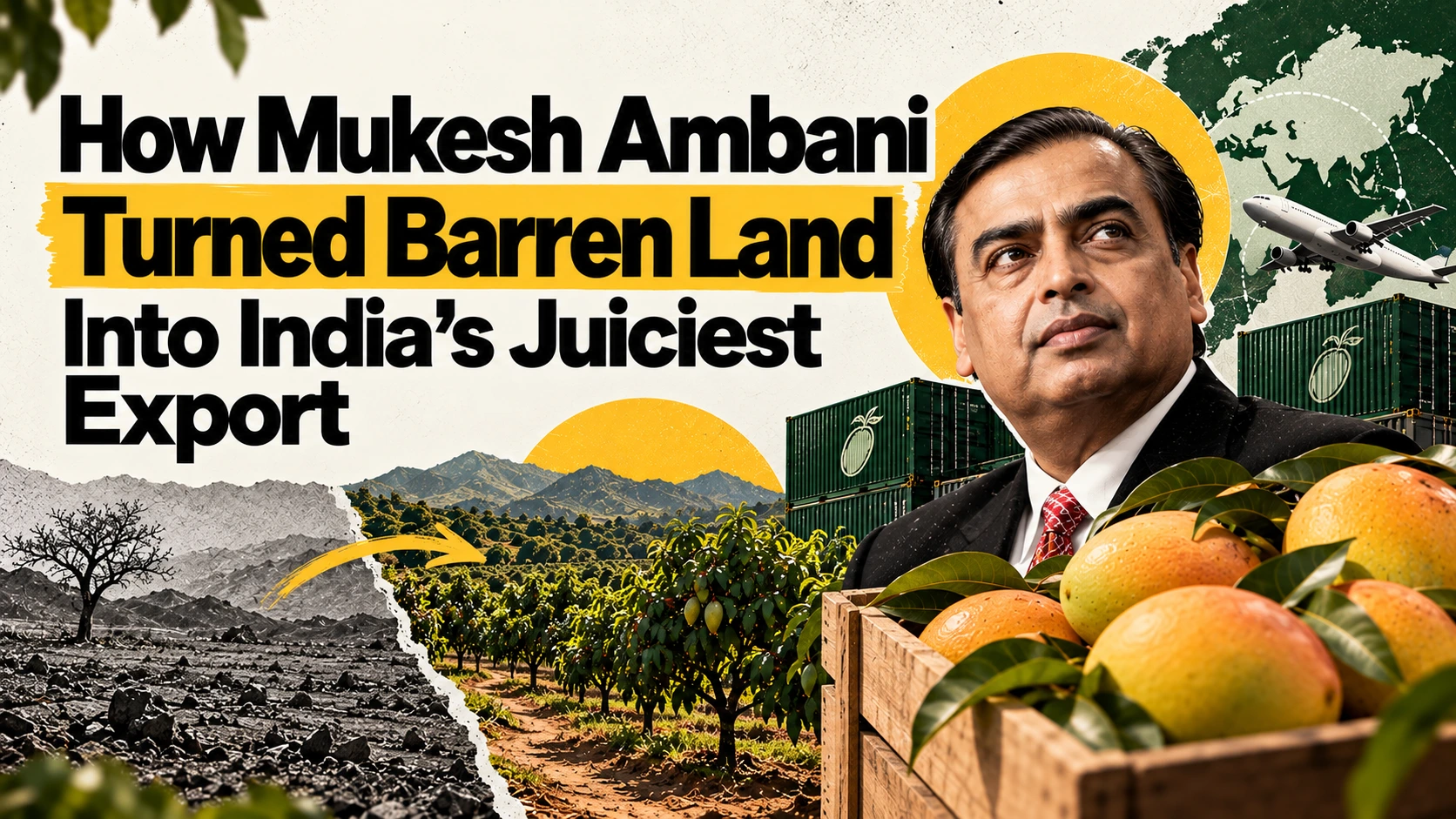
What would you do with 600 acres of land that barely looked capable of supporting a serious agricultural operation?
Most people would probably walk away.
Reliance did the opposite.
And this was not simply a story about planting a few mango trees.
It was a story about changing the economics of land.
Land that appeared difficult to cultivate was approached as a problem that could potentially be solved through technology, water management, horticultural expertise, careful planning and scale.
Today, the Jamnagar orchard is one of the most fascinating examples of large-scale mango cultivation in India.
It is also a useful learning for anyone interested in agriculture, mango farming, productive farmland and managed farmland investment.
Because the most interesting part of the story isn’t that Mukesh Ambani has a mango orchard.
It is how Reliance made the land productive in the first place.
The Unlikely Beginning of the Jamnagar Mango Orchard
The story begins in the late 1990s, when Reliance was developing its massive refinery complex in Jamnagar.
The surrounding environment was not exactly what most people would associate with a thriving mango orchard.
Jamnagar sits in the arid Saurashtra region of Gujarat, where water availability, salinity and climatic conditions present significant agricultural challenges.
At the refinery, Reliance also had an environmental requirement to establish substantial green cover around the industrial complex.
Instead of treating the green belt as simply landscaping, the company began exploring whether the land could support something far more ambitious.
What if the green belt could become productive?
That question led to a horticultural experiment.
Reliance’s own historical material describes how the arid land around the Jamnagar refinery was transformed into a green belt using irrigation and other interventions, with the Lakhi Bagh mango plantation becoming a major part of the initiative.
What began as an environmental requirement eventually developed into something much bigger.
A commercial horticultural project.
And eventually, an enormous mango orchard.
Why the Land Was So Difficult
It is easy to look at photographs of the orchard today and forget what the site looked like before the transformation.
That is precisely what makes the story interesting.
Agriculture does not begin with a green field.
It begins with understanding the conditions you actually have.
The Jamnagar region presented several challenges, including arid conditions and water scarcity. Historical material about the project describes the site’s shallow, relatively low-fertility soils, high pH and salinity, along with limited natural water availability.
For conventional farming, these conditions would make the proposition considerably more complicated.
But Reliance approached the problem differently.
Instead of asking whether the land was naturally ideal for mangoes, the project effectively asked:
What would it take to make the land capable of supporting a productive orchard?
That shift in thinking is important.
Good agricultural development is not always about finding perfect land.
Sometimes, it is about understanding imperfect land and building the right system around it.
The Green Belt That Became an Agricultural Experiment
The Jamnagar project was initially connected to the creation of a large green belt around the refinery.
But Reliance did not stop at conventional landscaping.
The company developed a horticultural operation involving mangoes and other crops.
Its historical CSR material notes that the green belt included mangoes alongside fruits such as fig, tamarind, grapes, guava, pomegranate, ber, cashew and amla, as well as medicinal and aromatic plants.
The scale was extraordinary.
Reliance later described the Jamnagar site as having 138,000 mango trees at a single location, calling it the largest mango orchard in Asia.
That scale changed what was possible.
Large-scale farming could justify serious investment in irrigation, agricultural research, infrastructure, monitoring and post-harvest handling.
The orchard was no longer simply a plantation.
It was becoming a managed agricultural system.
How Technology Changed the Equation
This is arguably the most important part of the story.
The Jamnagar orchard was not created by simply putting mango saplings into the ground and hoping for the best.
Technology and agricultural management became central to the project.
Drip irrigation
Water is one of the most important constraints in agriculture, particularly in arid environments.
Drip irrigation allows water to be delivered much closer to the plant’s root zone rather than relying on conventional flooding methods.
Reliance’s historical material specifically highlights the use of drip irrigation in developing the Jamnagar green belt.
Water management
The broader Jamnagar complex has also incorporated water recycling and rainwater harvesting infrastructure as part of its environmental systems. Reliance says its Jamnagar operations use recycled water and have developed substantial rainwater-harvesting capacity.
For an agricultural project, this is a crucial lesson:
Productivity depends not only on the crop, but on the systems supporting the crop.
High-density cultivation
The project also experimented with dense mango planting.
Historical reports describe high-density mango cultivation across significant portions of the orchard, with plant densities varying by the specific area and planting design.
The idea is straightforward.
Instead of thinking only in terms of “how many acres do I have?”, modern horticulture asks:
How efficiently can each acre be used?
That is a very different mindset.
Why Mangoes?
Why did Reliance choose mangoes?
The answer is partly cultural, partly commercial and partly agricultural.
Mango is one of India’s most important fruit crops, with enormous domestic demand and a long-established export market.
India grows hundreds of mango varieties, although only a smaller number are cultivated commercially at significant scale.
Mango also has something few agricultural commodities can match.
It has a strong emotional identity.
Alphonso, Kesar, Dasheri, Langra, Banganapalle and other varieties have loyal consumer bases across India and overseas.
That makes mango more than a commodity.
For the right producer, it can become a differentiated agricultural product.
The scale and diversity allowed the project to function as more than a single-variety orchard.
It became a horticultural showcase.
From Orchard to Commercial Agriculture
Growing mangoes is only half the story.
You can have the healthiest orchard in the world, but if the fruit never reaches the right market, the economics of the farm remain incomplete.
This is where the Jamnagar story becomes particularly relevant for modern agriculture.
Reliance eventually moved beyond cultivation into the commercial side of the mango business.
Historical reporting shows that the company developed an export strategy for its mangoes, including Kesar mangoes entering European markets.
Reliance also established Jamnagar Farms as a separate agricultural business associated with the farming operation and planned to target export markets.
That created a complete agricultural value chain:
- Land
- cultivation
- harvest
- packhouse
- market
- export
And this is where many people misunderstand farming.
Agriculture is not simply about growing something.
It is about creating a system in which the crop can be grown efficiently, harvested properly, handled well and sold into the right market.
The farm gate is not the finish line.
It is the beginning of the commercial journey.
What the Jamnagar Story Teaches Us About Productive Farmland
The Ambani mango orchard offers a lesson that goes far beyond mangoes.
Land has potential, but potential alone does not create productivity.
Productive farmland is the result of several things working together:
- The right crop
- Agricultural expertise
- Water and farm infrastructure
- Technology
- Consistent management
- Harvest planning
- Market access
- Long-term thinking
Take any one of those away and the outcome can change significantly.
This is why simply purchasing agricultural land does not automatically create a productive agricultural asset.
The land needs a plan.
The crop needs management.
And the produce needs a route to market.
That is perhaps the biggest takeaway from Jamnagar.
Why Modern Farming Is Becoming a Management Game
There was a time when farming knowledge was passed almost entirely from one generation to another.
That knowledge remains incredibly valuable.
But modern commercial agriculture has added another layer.
Today, large agricultural operations increasingly depend on:
- Irrigation systems
- Crop monitoring
- Soil and water management
- Horticultural research
- Improved planting techniques
- Post-harvest handling
- Supply-chain planning
- Market intelligence
The farmer is no longer only a cultivator.
They are also managing a biological production system.
The larger the operation becomes, the more important systems become.
And this has implications for urban investors.
Someone may understand the value of owning land without having the slightest interest in learning how to manage 500 mango trees.
That is not a contradiction.
It is precisely where professional farm management becomes valuable.
Can Ordinary Investors Replicate the Ambani Model?
Well…
A 600-acre industrial-scale orchard backed by one of India’s largest conglomerates is not a blueprint that an individual investor can simply copy.
But the principles behind the project can be understood.
You do not need 600 acres to appreciate what the Jamnagar story demonstrates.
The principles are much simpler:
- Make the land productive.
- Use agricultural expertise.
- Invest in the right infrastructure.
- Manage water intelligently.
- Think beyond cultivation and consider the market.
- Treat agriculture as an organised operation rather than a passive piece of land.
This is where the concept of managed farmland becomes particularly relevant.
The modern urban investor may want the ownership and productive potential of agricultural land without taking on the responsibility of running the farm personally.
Where Managed Farmland Enters the Picture
This is perhaps the most useful lesson to take from the Jamnagar story.
Reliance did not create one of India’s most remarkable mango orchards by treating farming casually.
It brought together land, technology, horticultural expertise, infrastructure and management.
An individual investor does not need to recreate that entire ecosystem alone.
A professionally managed farmland model can separate ownership from agricultural operations.
- The landowner owns the asset.
- The agricultural team manages the orchard.
- The farm produces.
- The harvest is taken to market.
And, depending on the structure, the landowner can participate in the economics generated by the agricultural activity.
That is what makes managed farmland particularly interesting for urban professionals.
You can participate in agriculture without making farming your second career.
What Mangofolks Can Learn From the Jamnagar Model
The Jamnagar story is obviously on a completely different scale from a managed farmland project designed for individual landowners.
But the underlying philosophy is relevant.
Productive farmland requires more than land.
- It requires people who understand agriculture.
- It requires systems.
- It requires long-term orchard management.
- And it requires an understanding of what happens to the produce after it leaves the tree.
Mangofolks takes a management-first approach to its managed mango orchard model.
Its model combines land ownership with professional orchard management, with agronomists and the farm team handling cultivation and agricultural operations.
For an urban investor, that creates a much simpler relationship with agriculture.
That means the attraction is not simply “buy a piece of farmland.”
It is own a productive agricultural asset with the systems and expertise required to manage it.
Mangofolks also reserves open space within its farmland projects, creating the possibility of additional lifestyle value, such as personal use or a future farmhouse, and potentially other permitted nature-based or experiential uses, subject to the applicable regulations and permissions.
That makes the proposition broader than agriculture alone.
It is about owning land that can have a purpose.
- A productive orchard.
- A potential source of agricultural income.
- A place to spend time with family.
- And, over the long term, an asset that can become part of a family’s wealth story.
The Bigger Lesson: Don’t Ask Whether Land Is Productive. Ask What Makes It Productive.
This is the real story behind Mukesh Ambani’s Jamnagar mango orchard.
The impressive part is not simply the number of mango trees.
It is the transformation in thinking.
Barren land was not treated as useless land.
It was treated as land with a problem to solve.
- Water was managed.
- Technology was introduced.
- Agricultural expertise was applied.
- Mango varieties were cultivated at scale.
- The orchard was professionally managed.
And eventually, the produce was connected to commercial markets, including export opportunities.
That is a powerful way to think about agriculture.
And that is why the idea of managed farmland is becoming increasingly relevant to urban investors.
You don’t necessarily need to become a farmer.
You need to understand the difference between owning land and owning productive land.
The first gives you an asset.
The second can give that asset a purpose.
FAQs
How did Reliance Industries turn barren land into a mango orchard?
Reliance developed a large green belt around its Jamnagar refinery and used agricultural and water-management techniques to establish extensive horticulture in an arid environment. The initiative eventually included a huge mango plantation known as the Dhirubhai Ambani Lakhibag Amrayee. Reliance’s own materials describe the use of irrigation and the transformation of arid land into a major green area.
How large is Mukesh Ambani’s mango orchard?
Reliance has described the Jamnagar site as having around 138,000 mango trees at a single location and as Asia’s largest mango orchard in an arid region. Other historical reports have cited a 600-acre orchard and more than 100,000 trees. Exact figures have varied across reports and over time as the broader green belt and orchard have developed.
Does Reliance export mangoes?
Reliance has pursued mango exports from its Jamnagar agricultural operations. Historical reporting documented the export of Kesar mangoes to European markets and the company’s efforts to build an export-oriented fresh-produce business.
What makes the Jamnagar mango orchard successful?
Its scale is only one part of the story. The project combines horticultural expertise, irrigation, water management, plantation techniques, agricultural research, infrastructure and commercial market access. The larger lesson is that productive agriculture depends on an integrated system rather than land alone.
Can individual investors own managed farmland?
Managed farmland models allow investors to own agricultural land while professional agricultural teams handle agreed farming operations. The ownership structure, management responsibilities and commercial arrangements vary by project, so investors should review the specific documentation and seek appropriate professional advice.
What can investors learn from Reliance’s mango farming model?
The biggest lesson is that productive farmland requires management. Land becomes commercially useful when the right crop, agricultural expertise, infrastructure, technology and market access are brought together. This principle applies far beyond mango farming.
Key Takeaway
The Jamnagar mango orchard is fascinating because it challenges a very old assumption about agriculture:
that land is either naturally productive or it isn’t.
Reliance demonstrated something more interesting.
With the right systems, expertise, infrastructure and long-term approach, difficult land can potentially be transformed into a productive agricultural asset.
That does not mean every piece of barren land can become a mango orchard. It does mean that land should be evaluated for its potential, not just its present appearance.
And perhaps that is the most valuable lesson for today’s urban investor.
- You don’t have to own 600 acres.
- You don’t have to build a refinery.
- And you certainly don’t have to become Mukesh Ambani.
But you can understand the principle behind what happened at Jamnagar:
Good farmland is not simply land. It is land + agriculture + management + productivity.
That is precisely why professionally managed farmland is becoming an increasingly interesting proposition for people who want to participate in agriculture without taking on farming as a full-time occupation.
The next time you see a mango orchard, look beyond the fruit.
Ask what made those trees possible in the first place.
That is where the real story begins.