

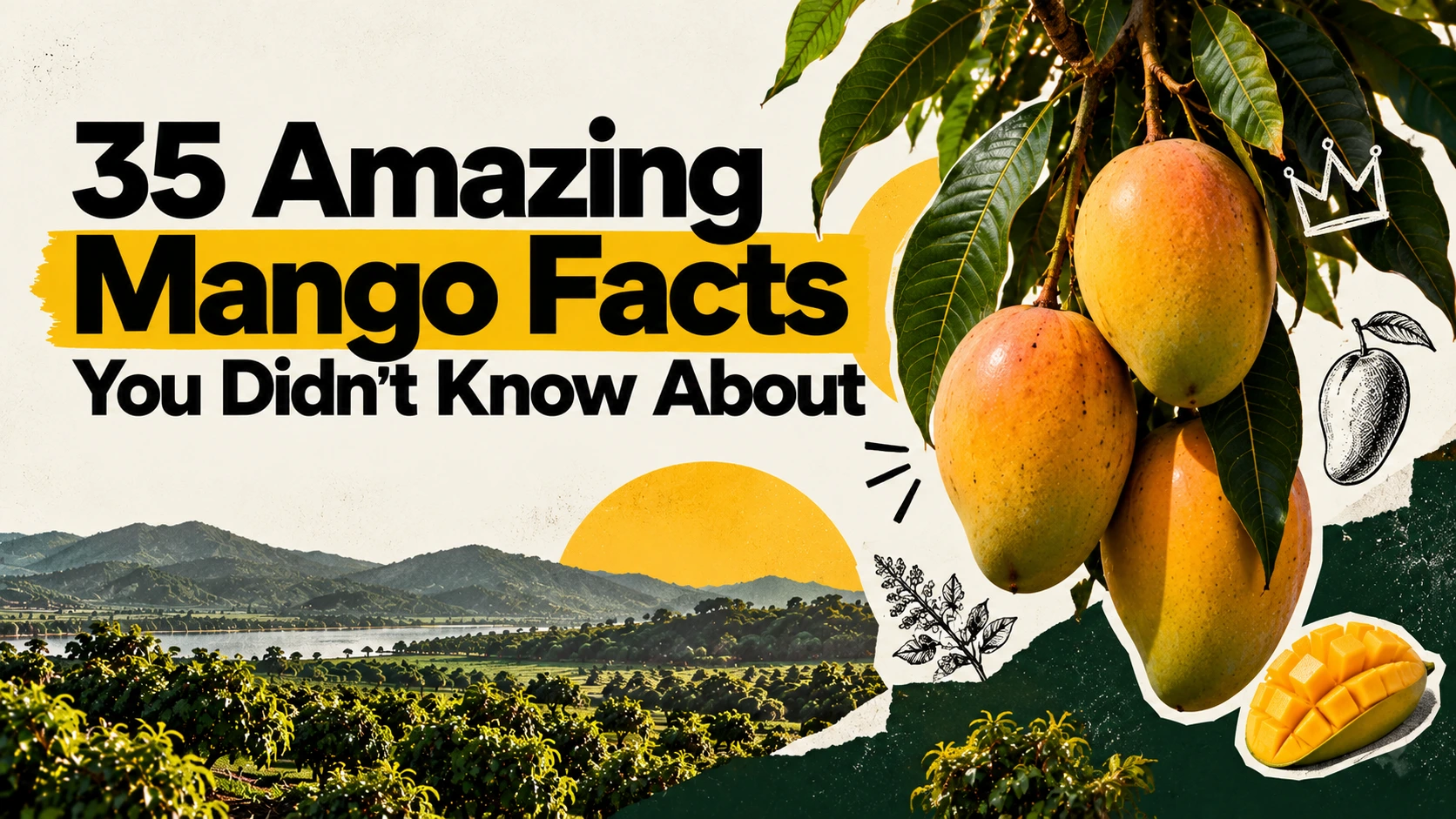
There are people who like mangoes.
And then there are people who hear the word “mango” and immediately start defending their favourite variety.
- “Alphonso.”
- “No. Kesar.”
- “Langra.”
- “Ratnagiri Hapus.”
- “Actually, you haven’t tried the good ones from my hometown.”
You know how this goes.
But here’s the funny thing.
For all the drama surrounding mangoes, most of us know surprisingly little about the fruit itself.
Did you know a mango tree can produce an inflorescence containing more than 3,000 flowers?
Or that the world’s heaviest recorded mango weighed 4.25 kg?
Or that the word mango travelled into English through Portuguese?
Or that a pattern you’ve probably seen on shawls, shirts and handbags was inspired by the shape of a mango?
The mango has been quietly collecting fascinating stories for thousands of years.
So let’s get into them.
And fair warning: by the end of this article, you may look at your next mango slightly differently.
Mangoes Are Older Than Most Things You Associate With Mangoes
Mango cultivation in India goes back at least 4,000 years.
Think about that.
The mango was being cultivated long before supermarkets, refrigeration, modern agriculture, food delivery and somebody inventing the mango shake.
It has been part of South Asian life for so long that it can feel less like a crop and more like a permanent member of the family.
And it has been cultivated for so long that humans have had thousands of years to do something very human:
Make more versions of it.
Which brings us to number two.
India Has Roughly 1,000 Mango Varieties
Around a thousand mango varieties are found in India, although only a much smaller number are commercially cultivated at scale.
So when someone says, “I don’t like mangoes,” the correct response may be:
“Which mango?”
Because rejecting mangoes after trying one variety is a bit like watching only one genre movie and deciding you don’t like cinema.
A Mango Has a Scientific Name That Sounds Like a Spell from Harry Potter.
The mango’s botanical name is:
Mangifera indica.
The indica part is a little nod to its deep association with India.
Mangoes Are Related to Cashews
Here’s a family connection you probably weren’t expecting.
Mango belongs to the Anacardiaceae family.
So does cashew.
And pistachio.
Which means your summer mango and your kaju katli have a distant botanical relationship.
Family reunions must be interesting.
A Mango Isn’t Technically Just “A Fruit”
Botanically, mango is a drupe, or stone fruit.
That puts it in the same broad category as peaches, plums and cherries.
The hard structure surrounding the seed is what gives it away.
So technically, when you’re wrestling with that enormous mango seed trying to scrape off the last bit of pulp, you’re dealing with the defining feature of a botanical stone fruit.
You were not wasting mango.
You were conducting botany.
One Mango Flower Cluster Can Contain More Than 3,000 Flowers
This might be the most wild thing about mango trees.
And then you look at a mango sitting peacefully on your kitchen counter and realise it started life as one tiny flower among thousands.
Of course, most flowers don’t become mature mangoes.
Which makes every successful mango seem slightly more impressive.
The Flowers Are Tiny
Now combine the previous fact with this one.
The flowers in those enormous clusters are tiny.
So you have a large tree producing huge sprays containing thousands of very small flowers, and eventually some of those flowers become the mangoes you and your family love.
Nature has a strange sense of scale.
Mango Trees Can Be Huge
Mango trees can reach around 10 to 45 metres in height, depending on the tree and growing conditions.
That’s potentially taller than a lot of buildings.
And the canopy can become enormous too.
Which means the mango tree you casually think of as “the thing that gives us mangoes” can actually be a serious piece of architecture.
Only greener.
And much tastier.
Mangoes Come in Completely Different Shapes
Mangoes are not particularly committed to one body shape.
- Some are round.
- Some are oval.
- Some are long.
- Some have a pronounced point.
- Some are almost kidney-shaped.
- Some look like they have been gently squashed from one side.
ICAR describes mango fruit as
“exceedingly variable in form and size.”
Which is scientific language for:
Mangoes basically do whatever they want.
The Colour of a Mango Can Lie to You
You see a green mango and think:
“Not ripe.”
Careful.
Some varieties remain green even when ripe.
Langra is the classic example.
So the mango sitting in front of you could be perfectly ready to eat while looking like it still needs another week.
The mango has successfully defeated the most basic visual test we give to fruit.
Totapuri Looks Like a Mango That Grew a Beak
Look at a Totapuri.
It has a long, distinctive shape with a pointed end.
Hence the name and the famous parrot-beak resemblance.
It is also widely used in processing.
So while Alphonso gets invited to glamorous dinner parties, Totapuri is somewhere quietly running the mango pulp industry.
The Mango You Eat Could Be More Than One Colour
The skin of mangoes can be green, yellow, red or combinations of these.
The mesocarp can also range from pale yellow to deep orange.
And here’s the fun part:
the outside doesn’t always tell you what’s happening inside.
Sometimes you cut open a mango expecting one thing and get something completely different.
The mango equivalent of opening a mystery box.
Mangoes Have Been Cultivated for So Long That We Don’t Have One Single “Original” Mango
Thousands of years of cultivation, selection and propagation have produced an enormous diversity of mangoes.
That’s why the mangoes of India aren’t simply different “brands” of the same fruit.
They can differ in flavour, aroma, texture, fibre, colour, shape, size and season.
What you’re seeing today is the result of a very long relationship between people and trees.
Basically, humans spent thousands of years saying:
“This one is good. Let’s grow more of this one.”
And then doing it again.
And again.
And again.
Emperor Akbar Was Apparently Not Playing Around
Mango obsession isn’t a modern phenomenon.
Historical accounts describe Mughal Emperor Akbar establishing an orchard of around 100,000 mango trees, known as Lakhi Bagh, near Darbhanga.
One hundred thousand trees.
Imagine being told:
“How many mango trees should we plant?”
And answering:
“Yes.”
The scale is extraordinary even by today’s standards.
Mangoes Were Important Enough to Make It Into Royal Politics
Mangoes weren’t merely sitting in royal orchards looking pretty.
They were valued, cultivated, exchanged and discussed at royal courts.
Different varieties developed reputations, and mangoes became part of the culture surrounding rulers and gardens.
In other words, people have been arguing about premium mangoes for a very long time.
The Word “Mango” Took a Long Journey Too
Here’s a tiny piece of linguistic history.
The English word “mango” is generally traced through Portuguese manga, with earlier South Indian linguistic roots including Tamil.
So even the word itself travelled.
- The fruit travelled.
- The varieties travelled.
- The cultivation knowledge travelled.
- The name travelled.
At this point, mangoes have basically had a more interesting passport than most of us.
The Paisley Pattern Has a Mango Connection
Look at a paisley pattern.
That familiar curved, teardrop-like shape?
It has a long association with the mango motif in South Asian art and textiles. In India, related forms are known by names such as ambi or other regional terms.
So that pattern on your scarf, shirt or bedsheet may be carrying a tiny mango reference.
The mango has apparently been doing fashion for centuries.
Mango Is the National Fruit of India
This one you may know.
Mango is the national fruit of India.
But here’s what makes that particularly fitting.
India doesn’t have one dominant mango variety.
It has an absurd variety of them.
So even our national fruit comes with an argument over which version is best.
Very Indian.
Mango Is Also the National Fruit of Pakistan and the Philippines
And now it gets interesting.
Mango is also recognised as the national fruit of Pakistan and the Philippines.
Three countries.
One fruit.
Millions of opinions about which variety is superior.
Somehow, nobody has created a Mango Olympics yet.
Mango Cultivation Travelled From South Asia to Southeast Asia Centuries Ago
Mangoes didn’t stay where they originated.
APEDA records that mango cultivation spread into Southeast Asia between the 5th and 4th centuries BCE, and later reached East Africa.
Eventually, mango cultivation spread much further into tropical and subtropical parts of the world.
So the mango has been travelling internationally for a very, very long time.
Mangoes Can Keep Ripening After They Leave the Tree
Mangoes are climacteric fruits.
That means they can continue ripening after harvest.
This is one reason mangoes can be harvested before they are fully ripe and then allowed to mature later.
So when a mango is picked, its story isn’t necessarily over.
It’s just entering its final act.
Raw Mango and Ripe Mango Almost Feel Like Different Fruits
| Raw Mango | Ripe Mango |
|---|---|
| One is sharp. | One is sweet. |
| One is crunchy. | One is soft. |
| One gets turned into pickle, chutney and aam panna. | The other gets eaten over the sink while someone tells you not to drip on the floor. |
Same fruit.
Completely different personality.
Mangoes Have Their Own Little Chemistry Set
Mangoes contain compounds including mangiferin, quercetin and other polyphenols, alongside nutrients such as vitamin C, carotenoids and dietary fibre.
Which means the mango is not just a delicious orange object.
It is a surprisingly complicated little biochemical package.
Science has been studying what’s inside it for years.
You can continue studying it.
Or you can eat it.
Both are respectable choices.
Mangoes Are Not Just Food. They’re Ingredients
Mangoes can be turned into:
- Pulp.
- Puree.
- Juice.
- Nectar.
- Pickle.
- Chutney.
- Desserts.
- Dried products.
The fresh mango is just one version of the mango business.
The fruit can disappear into an entirely different product and still carry its flavour with it.
India Exported More Than 31,000 Tonnes of Fresh Mangoes in FY 2025-26
Mango may feel intensely local when you’re eating it in India.
The supply chain isn’t.
So somewhere in Canada, somebody is currently discovering what Indians have known for centuries.
Good luck going back to ordinary fruit afterwards.
Mango Pulp Is a Bigger Deal Than You Might Think
Fresh mango gets the attention.
Processed mango quietly does a lot of business.
That’s a lot of mango that never had to sit prettily in a fruit basket.
Some of it became an ingredient instead.
The mango has a career beyond being a mango.
The World’s Heaviest Mango Weighed 4.25 Kilograms
Let’s settle an important question.
How big can a mango get?
Apparently, ridiculously big.
At that point, you don’t slice the mango.
You schedule it.
The Family That Grew the Record Mango Actually Ate It
And this might be the best part.
After the record-breaking mango was documented, the family shared and ate the entire thing.
Honestly?
Correct decision.
Imagine having the world’s heaviest mango and then putting it in a museum forever.
No.
Cut it.
Share it.
Eat the historic mango.
Mangoes Can Be Surprisingly Big Without Looking Like It
Because mango varieties vary so dramatically, there is no single “normal” mango shape or size.
APEDA notes the enormous variation in Indian mangoes across shape, size, colour, flavour and aroma.
So the mango sitting next to another mango may technically be the same species.
Mango Trees Can Live for Decades
Mango is a perennial tree crop.
Unlike a seasonal vegetable that is planted, harvested and finished, a mango orchard is built around trees that can remain productive over many years.
That changes the entire rhythm of farming.
You aren’t simply growing this year’s crop.
You’re managing a living orchard over time.
Which is why mango farming is much more of a long game than the supermarket shelf suggests.
The Mango Season You See Started Months Earlier
When the first mangoes suddenly appear at the market, it can feel like someone flipped a switch.
But the orchard has been working long before you noticed.
- Flowering.
- Fruit development.
- Water management.
- Nutrition.
- Pest and disease management.
- Harvest preparation.
The mango season is basically the final episode of a much longer series.
You just happen to tune in for the best episode.
Mango Trees Don’t Just Produce Fruit. They Create an Entire Orchard Ecosystem
An orchard is not simply a grid of trees.
It is a living agricultural environment involving soil, water, roots, insects, microorganisms, sunlight, weather, farm workers and management decisions.
Every mango you eat is the output of all those things working together.
Which is why “just grow mangoes” is one of those sentences that sounds much easier than it actually is.
India’s Mango Diversity Is So Serious That Varieties Can Have Geographic Identity
Some Indian mangoes have obtained Geographical Indication status, connecting specific varieties and products with particular regions.
APEDA’s list includes GI-linked mangoes such as Alphonso, Gir Kesar, Malihabadi Dusseheri, Himsagar and others.
So sometimes, where a mango comes from isn’t just a detail.
It’s part of its identity.
Like a surname.
Except considerably more delicious.
One Mango Can Tell You a Lot About Agriculture
This is the fact that doesn’t sound like a fact at first.
A mango looks simple.
But producing one commercially involves an extraordinary number of variables.
- Variety.
- Climate.
- Soil.
- Water.
- Flowering.
- Pollination.
- Nutrition.
- Pest and disease management.
- Harvest timing.
- Post-harvest handling.
- Markets.
The fruit is simple.
The system behind it isn’t.
And perhaps that’s what makes mangoes so fascinating from an agricultural perspective.
The Mango Is Basically a 4,000-Year-Old Success Story
For thousands of years, humans have been looking at mango trees and figuring out how to grow better fruit.
- We’ve selected varieties.
- Moved them across countries.
- Developed orchards.
- Improved cultivation practices.
- Built processing industries.
- Created export systems.
And turned a fruit native to South Asia into something enjoyed around the world.
Yet after all that history, all that science and all that agriculture…
the average person still has the same objective:
Find the sweetest one.
Fair enough.
And That’s Why Mango Orchards Are More Interesting Than They Look
There is something wonderfully deceptive about a mango.
You hold one in your hand and it looks simple.
- Yellow.
- Orange.
- Green.
- Juicy.
- Done.
But behind that mango is an entire world.
- Thousands of years of cultivation.
- Hundreds of varieties.
- A tree that can grow enormous.
- Thousands of flowers.
- Water and soil management.
- Farmers and agronomists.
- Harvesting.
- Processing.
- Markets.
- Exports.
And a piece of land where all of it begins.
That’s also what makes a mango orchard interesting as farmland.
The land isn’t merely sitting there.
It can be cultivated.
Trees can grow on it.
Harvests can come from it.
And, with professional management, an urban landowner can participate in that agricultural model without personally becoming the person responsible for every irrigation schedule, pruning decision or harvest operation.
But perhaps the more important takeaway is much simpler.
The next time you pick up a mango, don’t just think:
“How much does this cost?”
Think:
“How many things had to go right for this to exist?”
Then eat it.
Preferably before someone else does.
Frequently Asked Questions About Mangoes
How many mango varieties are there in India?
India is home to approximately 1,000 mango varieties, although only a relatively small number are cultivated commercially at scale.
How old is mango cultivation in India?
Mango has been cultivated in India for at least 4,000 years, according to ICAR.
What is the botanical name of mango?
The botanical name is Mangifera indica.
Is mango related to cashew?
Yes. Mango belongs to the Anacardiaceae family, which also includes cashew and pistachio.
What is the heaviest mango ever recorded?
The Guinness World Record is 4.25 kg, grown in Colombia in 2020.
Can a green mango be ripe?
Yes. Some varieties, including Langra, can remain green even when ripe.
Is mango a stone fruit?
Yes. Botanically, mango is a drupe, commonly called a stone fruit.
Is mango the national fruit of India?
Yes. Mango is India’s national fruit.
How many flowers can a mango inflorescence have?
Some mango inflorescences can contain more than 3,000 flowers.
Why are there so many mango varieties?
Thousands of years of cultivation and human selection have produced mangoes with different characteristics including flavour, aroma, size, shape, colour and texture.
One Last Thing
The next time somebody tells you:
“It’s just a mango.”
You now have 35 reasons to disagree.
And, more importantly, you have a perfectly legitimate excuse to buy another box.
For research purposes, obviously.