

The Question Most People Think They’ve Already Answered
In context of Real Estate vs Farmland, If you ask someone where they would rather put their money, real estate or farmland, the answer usually comes quickly.
Real estate.
Not because they’ve deeply compared both.
But because real estate feels familiar, proven, and easier to explain at a dinner table.
Farmland, on the other hand, carries a certain ambiguity. It feels distant from everyday life, tied to agriculture, weather, labour, things most urban investors don’t interact with.
So the comparison rarely happens on equal terms.
And that’s exactly why it deserves a closer look.
Because once you move past perception and start examining how these two assets actually generate value, the answer becomes far more nuanced, and, in some cases, surprising.
What We’re Actually Comparing (And Why It Matters)
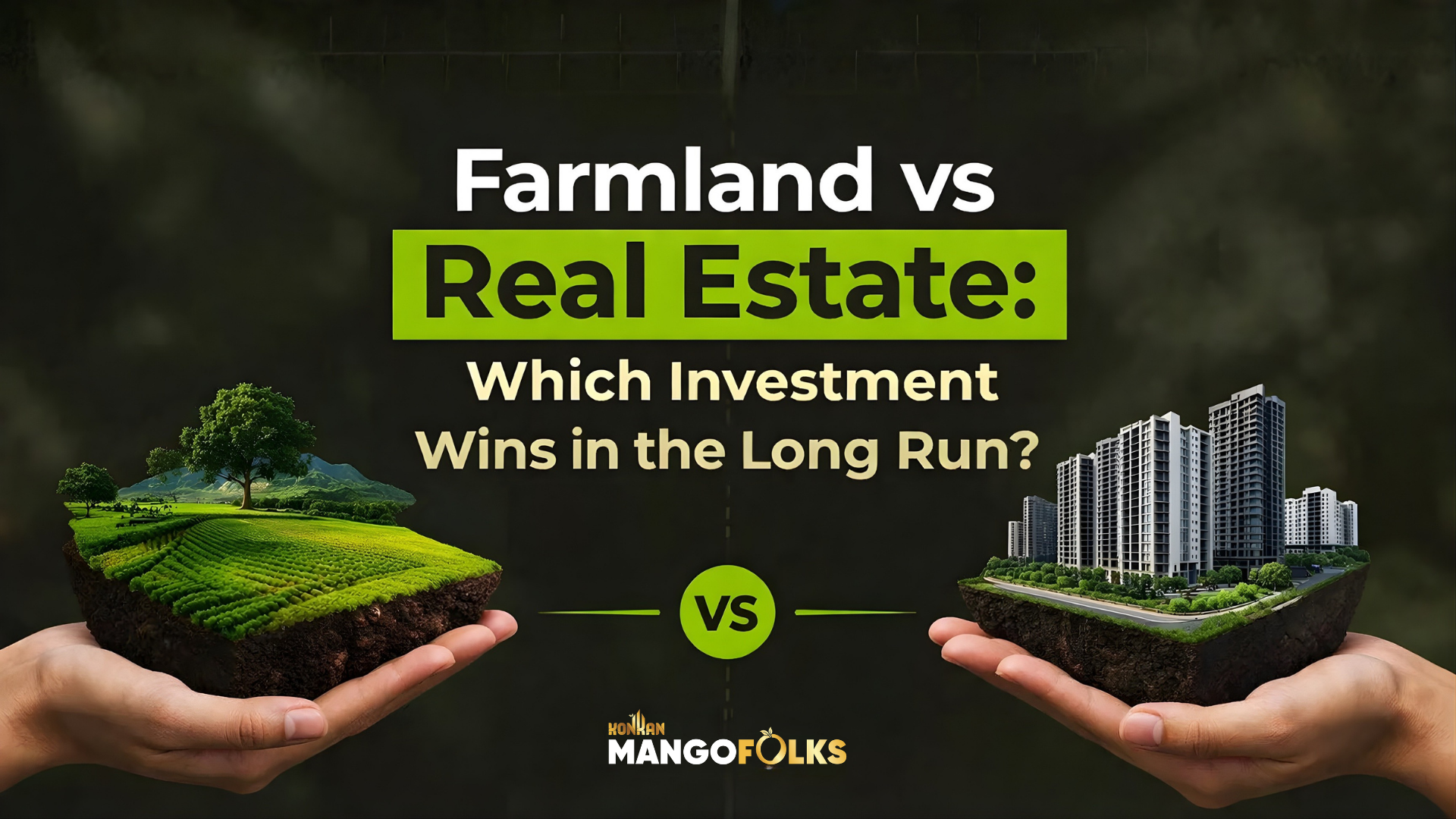
At a glance, both real estate investment and farmland investment in India involve buying land. That similarity, however, is almost superficial.
Real estate is typically a demand-driven asset. Its value depends on how many people want to live in it, rent it, or buy it later. The asset itself doesn’t produce anything—it waits for demand to act on it.
Farmland, particularly when used for cultivation or plantations, behaves differently. It is not just held; it is worked upon. It has the ability to generate output—crops, produce, yield—which introduces a second layer of value beyond appreciation.
This difference—between an asset that depends on external demand and one that can generate internal productivity—is where the entire comparison begins to shift.
How Real Estate Actually Makes Money
Let’s start with what most people already understand.
When you invest in real estate, your returns typically come from two sources:
- Capital Appreciation – The property increases in value over time, usually driven by infrastructure development, location desirability, and market demand.
- Rental Income – A steady, often monthly income stream generated by leasing the property.
On paper, this sounds ideal. And in many cases, it works.
But the reality is slightly more layered.
Rental yields in many Indian cities hover between 2–4%, sometimes lower when maintenance, vacancy, and upkeep costs are factored in. Appreciation, while powerful over long periods, is not guaranteed—it is heavily dependent on macroeconomic cycles and micro-location dynamics.
In other words, real estate performs well when the environment around it performs well.
How Farmland Generates Value (And Why It’s Different)
Now contrast that with farmland investment in India.
Here too, you have land appreciation working in your favour—especially in regions seeing infrastructure or industrial growth. But that’s only half the story.
The second half is agricultural yield.
Farmland, when cultivated efficiently, doesn’t just wait for value to increase. It actively produces it.
Take something like mango farming. In traditional setups, yields may be modest due to lower density and less optimized practices. But with modern approaches like high-density mango farming (UHDP), the equation changes significantly.
Instead of sparse planting, you now have:
- Higher tree density per acre
- Better resource utilization
- Improved consistency in output
Which means the same piece of land, under different systems, can produce entirely different financial outcomes.
This is why searches like “mango farming profitability in India” and “farmland ROI India” are increasing—because investors are beginning to see farmland not as passive land, but as a productive asset class.
The Core Difference: Demand vs Productivity
If you strip everything down, the difference between farmland vs real estate investment can be understood in one line:
- Real estate depends on demand
- Farmland depends on productivity
Real estate asks:
Will someone pay more for this in the future?
Farmland asks:
How much value can this land generate while I hold it?
That shift—from external dependence to internal generation—is subtle, but incredibly powerful in long-term investing.
Income Potential: Rent vs Yield
Income is where investors start to feel the difference in a very tangible way.
Rental income, while predictable in theory, comes with its own realities—tenant turnover, maintenance issues, occasional vacancy, and sometimes legal complications.
Agricultural income, on the other hand, has historically been seen as unpredictable and labour-intensive. And to be fair, it often was.
But this is where the evolution of managed farmland investment models becomes relevant.
With structured systems now in place—where professionals handle plantation, irrigation, crop cycles, and harvesting—the nature of farmland income begins to change. It becomes less about individual effort and more about system efficiency.
This is precisely why terms like “passive income from farmland India” and “managed farmland India” are gaining traction. The asset hasn’t changed. The way it is managed has.
Risk: What You’re Actually Dealing With
No comparison is complete without looking at risk, and here the distinction is again important.
Real estate carries what you might call market risk. If demand slows down, if supply increases, or if the economy dips, your returns can stagnate regardless of how well you’ve maintained your property.
Farmland, by contrast, carries execution risk. The outcome depends on how well the land is managed—what is grown, how it is grown, and who is responsible for that process.
This may sound like a disadvantage, but it also presents an opportunity.
Market risks are largely uncontrollable.
Execution risks, on the other hand, can be improved—through better systems, expertise, and management.
Liquidity: The Practical Concern
Let’s address a common hesitation.
Yes, real estate is generally more liquid than farmland. There is a broader buyer base, more established resale channels, and greater familiarity.
Farmland, especially agricultural land, can take longer to sell. The buyer pool is narrower, and regulations can vary.
But this gap is gradually narrowing, particularly in structured farmland projects where resale assistance and organized ownership models exist.
So while real estate still leads in liquidity, farmland is no longer as inaccessible as it once was.
Long-Term Wealth Creation: Where the Difference Compounds
This is where the comparison becomes less about features and more about behaviour over time.
Real estate is excellent for wealth preservation. It holds value, often grows steadily, and provides a sense of stability.
Farmland, when managed effectively, introduces an additional dimension—growth through production.
In plantation-based systems like mango orchards, yield is not static. Trees mature. Output increases. Systems improve. Over time, the asset doesn’t just sit—it evolves.
This creates a form of compounding that is not purely price-based, but productivity-based.
And over long horizons, that difference can become significant.
A Better Way to Decide
Instead of asking which is better, it helps to ask better questions.
- Are you looking for stability or growth?
- Do you prefer predictability or potential upside?
- Are you comfortable with market dependence, or do you prefer assets that can generate internally?
Because the answer is rarely absolute. It’s contextual.
Where Structured Farmland Models Change the Conversation
For a long time, farmland remained outside the mainstream investor’s consideration for one simple reason—it demanded involvement.
You couldn’t just buy it and forget it. You had to understand farming, manage labour, deal with uncertainties.
That’s no longer entirely true.
With the emergence of structured platforms, the experience is changing. Models like MangoFolks (by Konkan Estate) are built around this shift—where the ownership remains with the investor, but the operational complexity is handled professionally.
This includes:
- Access to clear-title agricultural land in Maharashtra
- Scientifically planned mango orchard investments using UHDP
- End-to-end management by agronomists
- Systems designed to support passive income from agriculture India
The result is not just convenience—it’s a redefinition of what farmland investment in India can look like.
It moves from being effort-driven to being system-driven.
And once that happens, the comparison with real estate starts to look very different.
Key Takeaways
- Farmland vs real estate investment is not a surface-level comparison
- Real estate is demand-driven; farmland is productivity-driven
- Real estate offers stability; farmland offers dual returns
- Modern managed farmland models are reducing complexity
- Long-term, farmland introduces a different kind of compounding
Final Thought
Real estate became the default investment not just because it performed well, but because it was easy to understand.
Farmland was left behind—not because it lacked potential, but because it lacked structure.
That gap is closing.
And as it does, the question is no longer whether farmland can compete with real estate…
But whether investors are ready to rethink what a “good investment” actually looks like.