

The Mango Tree Hasn’t Changed. The Way We Grow It Has.
For centuries, mango farming followed a simple philosophy.
Plant a tree.
Give it space.
Wait patiently.
And for generations, that worked.
The mango became more than a fruit. It became part of India’s agricultural identity, deeply woven into culture, commerce, and rural livelihoods.
Yet something interesting happened over the last few decades.
Demand increased.
Land became more valuable.
Water became even more precious.
Farmers and agricultural scientists began asking a different question.
Not:
“How do we grow more mango trees?”
But:
“How do we help the same acre of land become more productive?”
That question sparked one of the most significant shifts in modern horticulture.
And that is where the science of high-productivity mango farming begins.
What Does High-Productivity Mango Farming Mean?
High-productivity mango farming refers to cultivation systems designed to improve the efficiency of mango production through scientific orchard management.
Notice the word “efficiency.”
The goal is not simply producing more fruit.
The goal is creating a farming ecosystem where land, water, sunlight, nutrients, and tree growth work together more effectively.
This distinction matters.
Because productivity is rarely about one breakthrough.
It is usually the result of many small improvements working together.
Why Traditional Orchard Models Face Limitations
Traditional mango orchards were designed during a different era.
Land availability was higher.
Input costs were lower.
Population pressure was different.
As a result, trees were often planted with generous spacing, allowing them to grow naturally over many years.
While this approach has undeniable strengths, it also creates limitations.
Large trees often mean:
- Irregular canopy growth
- Uneven sunlight distribution
- More difficult harvesting
- Variable fruit quality
- Lower land-use efficiency
The challenge is not that traditional orchards are ineffective. The challenge is that modern agriculture increasingly demands greater precision.
And precision requires management.
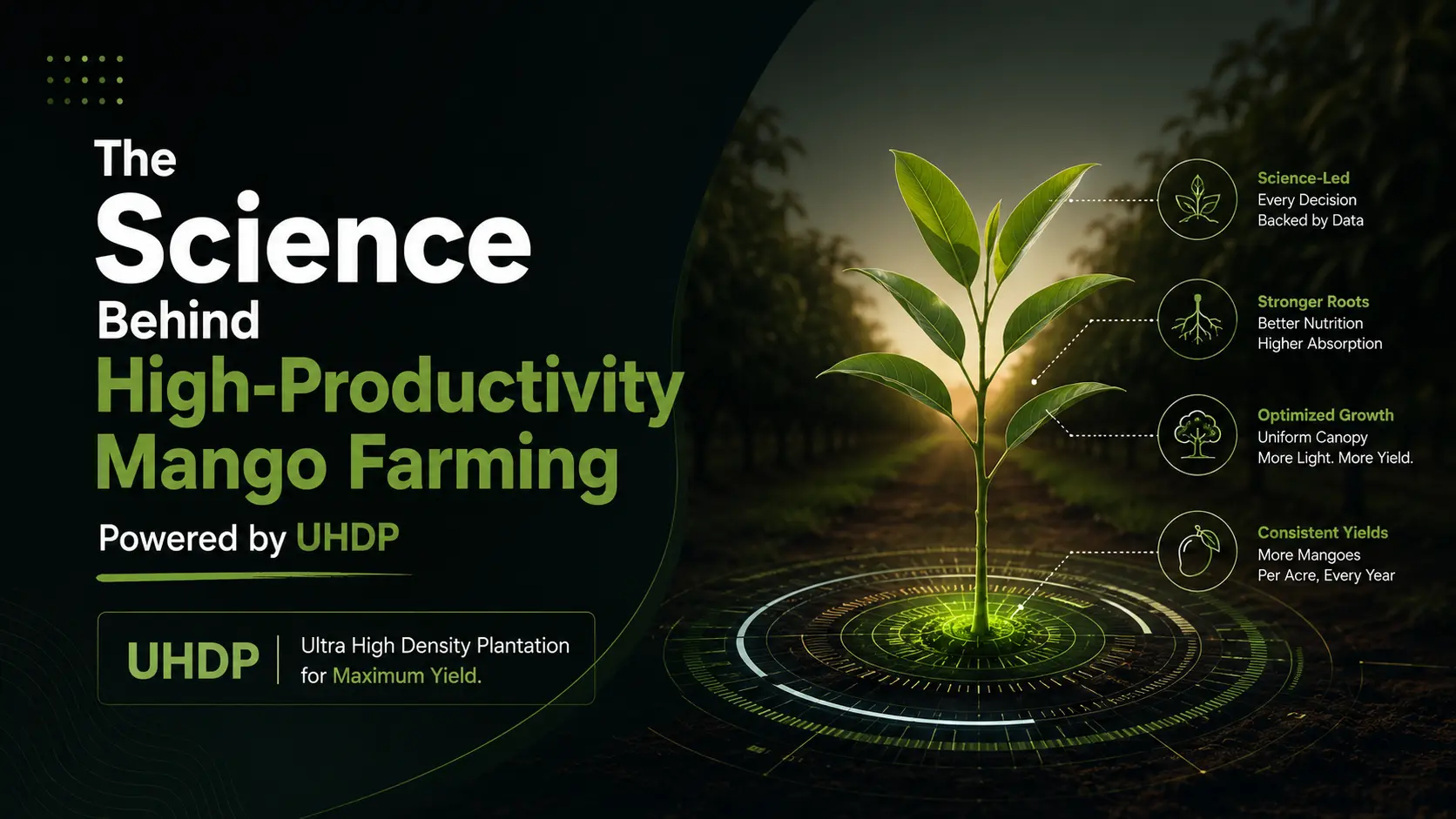
The Science Behind UHDP Farming
One of the most important developments in modern mango cultivation is UHDP, or Ultra High Density Plantation.
At first glance, UHDP seems simple.
More trees are planted within a given area.
But that is only part of the story.
The real innovation lies in how those trees are managed.
Instead of allowing unrestricted growth, UHDP focuses on:
- Controlled tree height
- Structured canopy development
- Planned sunlight exposure
- Efficient irrigation
- Consistent nutrient delivery
The objective is not to create bigger trees. The objective is to create smarter orchards.
This is why UHDP mango farming has become a major topic within discussions about modern horticulture and orchard productivity.
How Orchard Design Influences Productivity
Imagine two offices.
One is carefully designed for workflow and efficiency.
The other is completely random.
Even if both have talented employees, one will almost always perform better.
Orchards work similarly.
Productivity begins long before the first harvest.
It starts with layout.
Scientific orchard design considers:
- Tree spacing
- Sunlight access
- Air circulation
- Water distribution
- Maintenance accessibility
Every design decision affects the long-term performance of the orchard.
Poor layout creates obstacles.
Thoughtful layout creates opportunities.
The Critical Role of Canopy Management
Most people think mango productivity comes from roots.
In reality, much of the story happens above ground.
Without management, canopies can become:
- Overcrowded
- Uneven
- Less efficient
This affects:
- Sunlight penetration
- Air movement
- Fruit development
Modern orchard systems often use regular pruning and canopy management practices to maintain balance.
The result is not simply healthier trees.
It is a healthier orchard ecosystem.
Why Water Management Changes Everything
Water is one of the most valuable resources in agriculture.
But productivity is not always about using more water.
Often, it is about using water better.
Modern mango farming increasingly relies on precision irrigation systems designed to deliver water where and when it is needed.
Benefits may include:
- Reduced waste
- Improved root-zone moisture
- Better nutrient absorption
- Greater consistency
Soil Health: The Invisible Engine of Productivity
Walk through a mango orchard and your attention naturally goes upward.
The trees.
The leaves.
The fruit.
But productivity begins beneath your feet.
Healthy soil supports:
- Root development
- Nutrient availability
- Moisture retention
- Microbial activity
In many ways, soil functions like the foundation of a building. You rarely see it. But everything depends on it.
This is why successful mango orchard management increasingly focuses on long-term soil health rather than short-term interventions.
The Relationship Between Tree Health and Fruit Quality
Productivity is often measured in quantity.
But quality matters too.
A productive orchard is not simply one that produces fruit.
It is one that consistently produces healthy, marketable fruit.
Tree health influences:
- Fruit size
- Appearance
- Consistency
- Overall quality
This is why modern orchard systems emphasize preventive care rather than reactive solutions.
Healthy trees tend to perform more consistently over time.
And consistency is one of the most valuable assets in agriculture.
Technology’s Growing Role in Modern Mango Farming
The image of farming as purely manual work is becoming outdated.
Agriculture is increasingly becoming a blend of tradition and technology.
Today’s orchard management may incorporate:
- Weather monitoring
- Irrigation controls
- Data-driven planning
- Crop monitoring systems
The best agricultural systems combine experience with information.
That combination is helping shape the future of high-productivity farming in India.
Sustainable Productivity: The Future of Orchard Management
One of the biggest misconceptions in agriculture is that productivity and sustainability are opposites.
In reality, the strongest farming systems increasingly depend on both.
Sustainable mango farming focuses on:
- Resource efficiency
- Soil stewardship
- Water optimization
- Long-term orchard health
This creates a simple but powerful outcome.
The orchard remains productive without exhausting the resources that support it.
That balance is becoming increasingly important as agriculture evolves.
Because the future will not belong to farms that simply produce more. It will belong to farms that produce more intelligently.
How Managed Orchard Ecosystems Are Evolving
As modern farming becomes more specialized, a new model is emerging.
Instead of individual landowners managing every aspect of cultivation themselves, structured agricultural ecosystems are helping bring together:
- Scientific farming practices
- Professional orchard management
- Sustainable cultivation systems
- Long-term land stewardship
The lesson is not that technology replaces nature.
It is that better systems help nature perform at its best.
Key Takeaways
FAQs
High-productivity mango farming refers to cultivation systems designed to improve orchard efficiency through scientific management practices, optimized layouts, and resource-efficient farming techniques.
UHDP stands for Ultra High Density Plantation, a cultivation approach that focuses on structured orchard management, controlled tree growth, and improved land-use efficiency.
Canopy management helps improve sunlight distribution, air circulation, and overall orchard health, supporting more consistent productivity.
Healthy soil supports root development, nutrient availability, moisture retention, and overall tree performance.
Yes. Many modern agricultural systems aim to improve productivity while protecting soil, water, and long-term ecosystem health.