

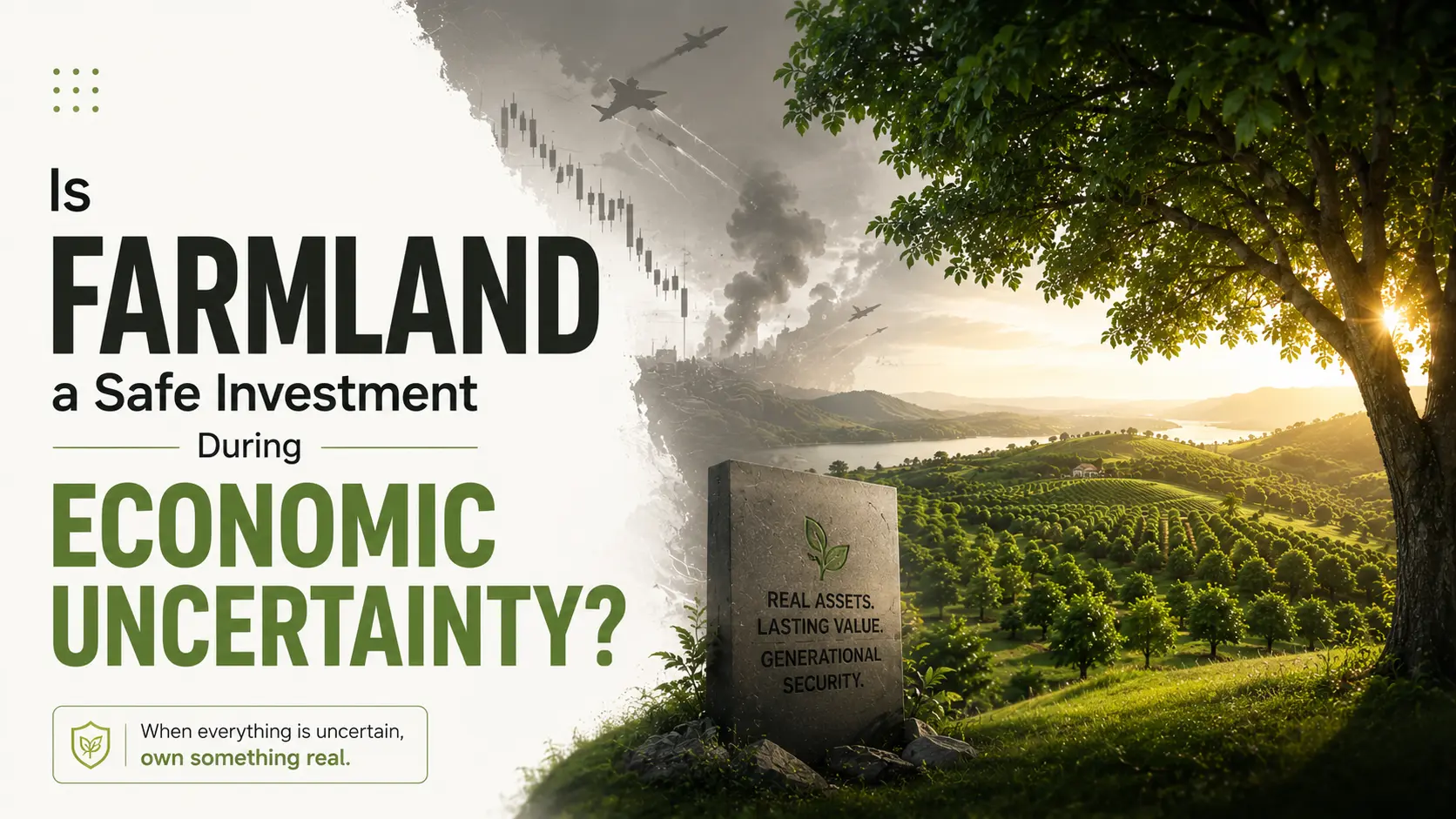
Why Economic Uncertainty Changes the Way We Think About Money
Economic uncertainty has a way of changing priorities.
When markets are booming, people often focus on growth.
When the future feels less predictable, they focus on resilience.
The questions become different.
Instead of asking:
“How fast can this grow?”
People begin asking:
“How well can this endure?”
History shows that periods of uncertainty often push investors toward assets they understand, can physically verify, and feel connected to.
That shift isn’t always financial.
Often, it’s psychological.
Because uncertainty doesn’t just affect portfolios.
It affects confidence.
And confidence is closely tied to how tangible and understandable an asset feels.
This is one reason why discussions around farmland investment in India, agricultural assets, and managed farmland ownership tend to increase whenever economic uncertainty becomes a major topic.
Not because farmland is immune to challenges.
But because it represents a very different kind of ownership.
What Makes an Asset Feel “Safe”?
Before discussing farmland specifically, let’s understand what people usually mean when they say “safe investment.”
Contrary to popular belief, safety is not the same as certainty.
No investment is completely free from risk.
Instead, people often associate safety with assets that offer:
- Tangibility
- Long-term relevance
- Clear ownership
- Lower emotional volatility
- Real-world utility
Notice something interesting.
None of those qualities are about hype.
They’re about durability.
And that distinction matters.
Because during uncertain times, investors often become less interested in excitement and more interested in stability.
Why Farmland Enters the Conversation During Uncertain Times
There is something fundamentally different about farmland compared to many modern asset classes.
Agricultural land is tied to something essential.
Food.
Land.
Natural resources.
Human necessity.
These are not temporary trends. They are enduring realities.
This is one reason farmland often maintains a unique place in conversations around long-term ownership.
Unlike assets that depend entirely on market sentiment, farmland is connected to physical ecosystems and productive land use.
For many people, that creates a sense of groundedness.
And during periods of uncertainty, groundedness becomes valuable.
The Difference Between Farmland and Other Asset Classes
One of the reasons farmland attracts attention is because it behaves differently.
Not better.
Not worse.
Just differently.
Stocks, for example, can react instantly to:
- news cycles,
- investor sentiment,
- global events,
- economic reports.
Farmland operates on a different timeline.
Agriculture is influenced by:
- seasons,
- land management,
- environmental conditions,
- long-term planning.
That slower rhythm creates a fundamentally different ownership experience.
Which is why many investors view agricultural assets not as replacements for traditional investments, but as complementary ownership categories.
The appeal often comes from diversification of experience as much as diversification of assets.
The Psychology of Tangible Ownership
This may be the most overlooked aspect of farmland ownership.
People do not only invest with spreadsheets. They invest with emotions.
A person may own:
- stocks,
- mutual funds,
- retirement accounts,
and still feel disconnected from what they actually own.
Farmland feels different because it is physical.
You can visit it.
Walk through it.
Observe it.
Understand it without needing a financial terminal.
This doesn’t automatically make it safer.
But it often makes it easier to comprehend.
And during uncertain periods, understandable assets frequently feel more reassuring than complex ones.
What Makes Farmland a Thoughtful Long-Term Ownership Choice?
Farmland brings together land ownership, agriculture, and long-term potential in a uniquely tangible way.
Its agricultural character is shaped by real-world factors such as:
- Weather conditions
- Water availability
- Land management
- Agricultural practices
- Operational quality
Understanding these elements helps owners gain a clearer perspective on the land, its management, and the agricultural ecosystem surrounding it.
Farmland is ultimately a long-term asset class connected to agriculture, nature, and productive land use.
And during periods of economic uncertainty, these characteristics can make farmland particularly interesting to those seeking a more tangible and grounded form of long-term ownership.
What Actually Makes Farmland Safer Than People Assume
The word “safe” is often misunderstood.
A more useful question might be:
What characteristics make farmland appealing during uncertain times?
Several factors contribute.
1. Tangibility
Unlike purely digital assets, farmland exists physically.
This gives owners a direct connection to what they own.
2. Essential Utility
Agriculture is tied to food systems and land use.
These remain relevant regardless of economic cycles.
3. Long-Term Perspective
Farmland naturally encourages a longer investment horizon.
Its value is often viewed through years and decades rather than daily fluctuations.
4. Lower Emotional Volatility
Agricultural ownership tends to be less influenced by short-term sentiment cycles.
That doesn’t eliminate risk.
But it can change the ownership experience significantly.
The Rise of Managed Farmland Models
One reason agricultural ownership is becoming more accessible is the growth of professionally managed farmland ecosystems.
Historically, owning farmland often meant managing farming itself.
That required:
- expertise,
- local presence,
- operational involvement.
Today, managed farmland models are helping bridge that gap.
In structured systems:
- farming operations are professionally managed,
- cultivation follows planned processes,
- and owners participate without needing to oversee daily agricultural activities.
This evolution has expanded interest among:
- urban professionals,
- entrepreneurs,
- NRIs,
- and individuals seeking nature-connected ownership experiences.
A Practical Framework for Evaluating Farmland Opportunities
Rather than asking whether farmland is “safe,” it can be more useful to ask whether a specific opportunity is well structured.
Consider the following framework:
This framework helps shift the conversation away from promises and toward fundamentals.
Which is usually where better decisions begin.
Common Mistakes People Make During Uncertain Times
Ironically, uncertainty often causes people to make worse decisions.
Some common mistakes include:
Choosing with clarity
Every asset has its own characteristics.
Prioritizing narratives over fundamentals
Compelling stories are not substitutes for transparency.
Ignoring operational quality
The management behind an asset often matters as much as the asset itself.
Thinking only about returns
The quality of ownership matters too. Particularly in long-term asset categories.
Why More Investors Are Looking at Agricultural Assets
A broader trend is emerging.
Investors are increasingly interested in assets that feel:
- tangible,
- understandable,
- future-relevant,
- and connected to real-world systems.
Agriculture naturally sits within that conversation.
Not because it guarantees outcomes.
But because it offers something modern ownership often lacks: a direct connection to physical reality.
This explains why discussions around:
- agricultural assets,
- managed farmland,
- sustainable land ownership,
- and orchard-based ecosystems
continue to gain attention.
The attraction is not purely economic.
It is philosophical too.
Where Modern Farmland Ownership Is Evolving
The most interesting developments in farmland today are happening at the intersection of:
- land ownership,
- professional management,
- sustainability,
- and transparency.
Rather than expecting individuals to navigate agricultural complexity alone, some platforms are building structured ecosystems around ownership.
Not speculative. Not complicated.
Simply more connected to the land itself.
Key Takeaways
FAQs
Farmland is often viewed as a long-term tangible asset, like many other investment options, with its own unique characteristics and considerations.
Many investors are drawn to tangible assets that feel grounded, understandable, and connected to essential real-world systems.
Managed farmland refers to agricultural land where cultivation and operations are handled by professional management teams.
Farmland remains closely connected to agriculture, food systems, and long-term land ownership, giving it enduring relevance across changing economic conditions.
Key considerations include land records, operational quality, transparency, management structure, and long-term suitability.