

There is a particular kind of weekend that feels increasingly rare.
You leave the city, drive past the last stretch of concrete, and suddenly the landscape changes. There are fields instead of buildings, trees instead of traffic, and a slower rhythm that you did not realise you were missing.
But what exactly are you looking for when you make that trip?
Are you interested in seeing how food is grown, walking through an orchard, understanding farming and experiencing rural life?
Or are you looking for something more connected to nature, biodiversity, open landscapes and the environment around you?
The answer often comes down to two closely related ideas: agritourism and ecotourism.
They overlap, but they are not the same.
Understanding the difference matters because the experience, purpose and relationship with the land can be quite different. And as rural travel, farm experiences and nature-led getaways become increasingly attractive, knowing what sits behind these terms can help travellers, landowners and investors understand the opportunities more clearly.
What Is Agritourism?
Agritourism, sometimes referred to as agricultural tourism, is tourism built around a working agricultural environment.
The simplest way to think about it is this:
Agritourism allows people to experience agriculture, farming and rural life more directly.
That could mean visiting an orchard during harvest, learning how a crop is cultivated, spending time on a farm, participating in selected agricultural activities, or simply experiencing the landscape and lifestyle surrounding a working agricultural property.
The important element is the connection to agriculture.
A farm is not merely a backdrop for the experience. It is part of the experience itself.
This makes agritourism particularly interesting in India, where agriculture is deeply connected to regional food, culture, traditions and landscapes.
A mango orchard in the Konkan, for example, can offer far more than a scenic view. Visitors can experience the trees, the seasonal rhythms of cultivation, the harvesting process, local food and the broader rural environment surrounding the orchard.
That is agritourism at its most natural.
What Is Ecotourism?
Ecotourism is broader in its relationship with nature.
At its core, ecotourism is about responsible travel to natural areas, with an emphasis on appreciating the environment, understanding ecosystems and supporting responsible interaction with the places being visited.
The emphasis is therefore not simply on visiting a beautiful natural place.
It is on doing so with an awareness of the surrounding ecosystem.
A forest walk, wildlife experience, biodiversity trail or nature-based retreat can fall within the wider idea of ecotourism when the experience is designed around responsible interaction with the natural environment.
The defining idea is therefore different.
Agritourism centres on agriculture. Ecotourism centres on nature and conservation.
The two can overlap, but their primary purposes are distinct.
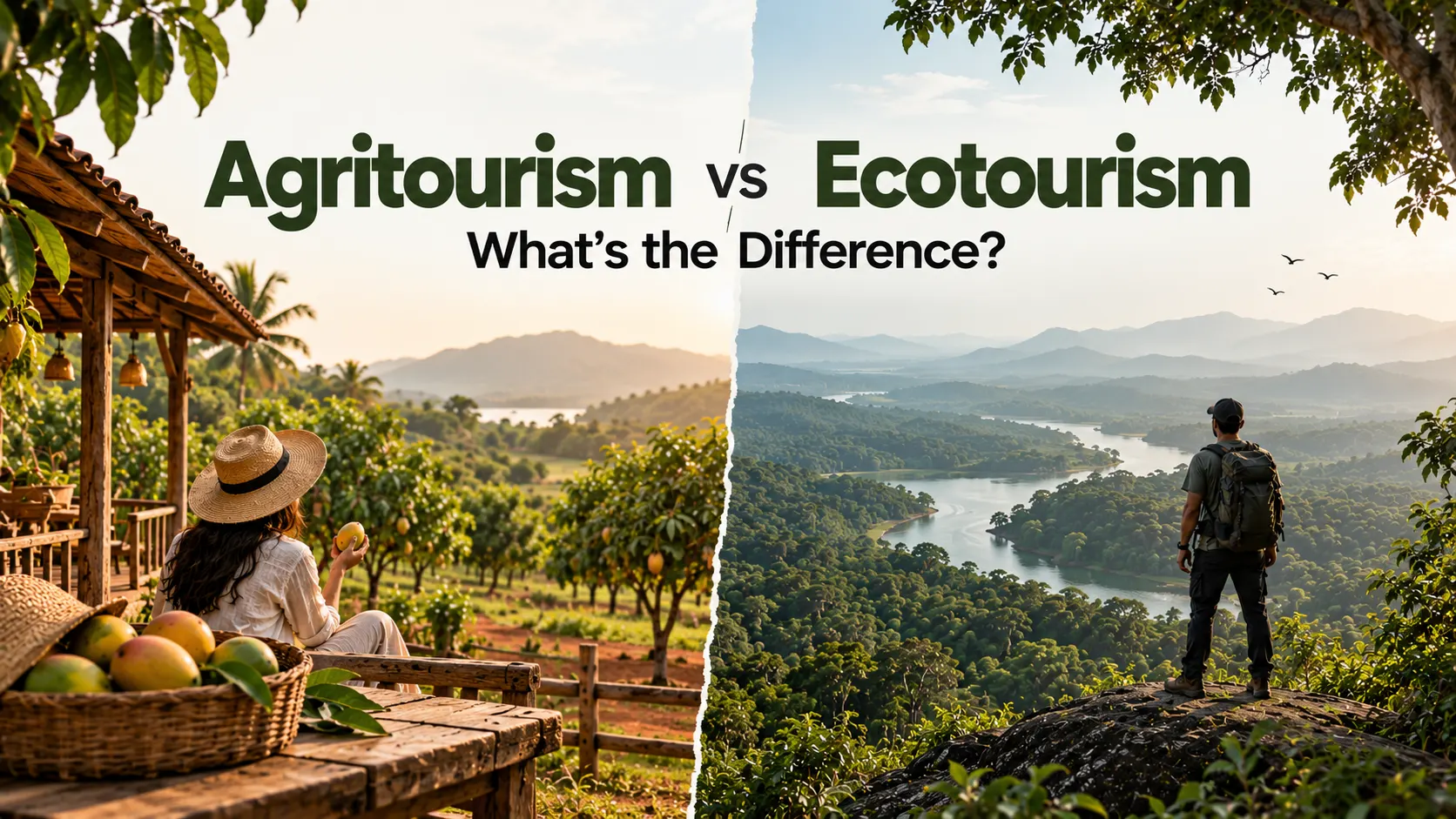
Agritourism vs Ecotourism: What’s the Difference?
The easiest way to understand the distinction is to look at what each type of tourism puts at the centre of the experience.
| Agritourism | Ecotourism |
|---|---|
| Centred around agriculture | Centred around natural environments |
| Working farms and agricultural landscapes are central | Natural ecosystems are central |
| Visitors learn about farming and rural life | Visitors learn about nature and ecosystems |
| Orchards, farms and plantations are common settings | Forests, wetlands, hills and other natural areas are common settings |
| Food production and agricultural traditions are often part of the experience | Conservation and environmental responsibility are central themes |
| Can support farm-based livelihoods | Can support conservation and local communities |
The distinction becomes clearer when you imagine the same landscape being approached from two different perspectives.
An orchard visit focused on how mangoes are grown, harvested and enjoyed would lean towards agritourism.
A guided nature trail through the surrounding landscape focused on birds, native vegetation and biodiversity would lean towards ecotourism.
And a well-designed rural destination can potentially offer both.
That overlap is where things become particularly interesting.
Why Are Agritourism and Ecotourism Becoming More Popular?
There is a larger cultural shift behind the popularity of both.
People are spending more of their lives surrounded by technology.
Work happens through screens. Social interaction happens through phones. Entertainment is increasingly digital. Even shopping, banking and communication can happen without leaving home.
At some point, people start wanting the opposite.
They want to see where food comes from.
They want to walk rather than scroll.
They want open spaces.
They want experiences that cannot be replicated on a screen.
This has helped create greater interest in rural experiences, nature retreats, farm stays and responsible tourism.
But the appeal is not necessarily about escaping modern life altogether. It is about finding something modern life does not always provide.
Space.
Quiet.
Perspective.
Connection.
And increasingly, people want those things without sacrificing comfort.
That combination is helping reshape what a rural getaway can look like.
What Makes Agritourism Different From a Normal Farm Visit?
Not every visit to a farm is automatically agritourism.
The experience becomes more meaningful when visitors are given an opportunity to understand the agricultural environment rather than simply passing through it.
For example, an agritourism experience might allow visitors to explore an orchard, understand how a crop is cultivated, experience seasonal farming activities, learn about local agricultural traditions or taste produce grown in the surrounding area.
The emphasis is on experience and understanding.
Agritourism can therefore become a form of informal agricultural education.
It closes a gap that modern life has created between people and the food they consume.
What Makes Ecotourism Different?
Ecotourism is less concerned with agricultural production and more concerned with the relationship between visitors and the natural environment.
A strong ecotourism experience might involve nature walks, wildlife observation, birdwatching, interpretation of local ecosystems, environmental education or low-impact outdoor experiences.
The goal is not simply to consume the landscape as a tourist attraction.
It is to understand it.
That distinction is important.
A beautiful forest should not become valuable only because people can photograph it. Its ecological importance exists independently of tourism.
Responsible ecotourism attempts to make tourism compatible with that reality.
It encourages visitors to appreciate the environment while recognising that the environment itself comes first.
Can a Farm Be Both Agritourism and Ecotourism?
Absolutely.
In fact, this is where things become particularly interesting.
Imagine a mango orchard surrounded by the natural landscape of the Konkan.
The agricultural experience might involve understanding mango cultivation, walking through the orchard and experiencing the harvest.
At the same time, the surrounding environment may provide opportunities to observe birds, explore local vegetation, experience the landscape and understand the relationship between agriculture and nature.
The experience has now moved beyond a simple category.
It has become a meeting point between agriculture and ecology.
This is one of the reasons thoughtfully designed rural destinations can be so compelling.
They do not necessarily have to choose between farming and nature.
They can allow visitors to experience how the two coexist.
And for landowners, that creates an interesting question: can productive agricultural land also become a place where people experience rural life, nature and hospitality?
The answer can be yes, provided such uses are thoughtfully planned and comply with applicable requirements.
The Benefits Go Beyond Tourism
The strongest case for agritourism is not simply that it gives people something interesting to do on a weekend.
It can create a deeper connection between consumers and agriculture.
Think about how disconnected the modern food chain can feel.
A person buys a mango.
They know its price. They know whether they like its taste. But they may never think about the tree that produced it, the farmer who cultivated it, the season that made it possible, or the landscape in which it grew.
Agritourism can close that gap.
It turns agriculture from something people consume into something they can understand.
Ecotourism can create a similar connection with nature.
Instead of simply seeing a forest as scenery, visitors begin to understand habitats, biodiversity and the delicate relationship between human activity and natural systems.
Both forms of tourism can therefore encourage greater appreciation.
And appreciation is often the first step towards responsible behaviour.
There is also an economic dimension.
When agricultural landscapes become capable of supporting carefully planned experiences, the value they create can extend beyond the crop itself. That does not mean every farm should become a hospitality business, nor does it mean additional income is automatic. It simply means that agriculture and tourism can sometimes coexist in ways that create additional possibilities for landowners and local communities.
What Should a Good Agritourism Experience Offer?
Not every farm experience needs to look the same.
But the strongest ones tend to have a few things in common.
Authenticity
The agricultural experience should feel connected to the actual farm rather than being a theme created purely for tourists.
Education
Visitors should leave understanding something they did not know before.
Connection
There should be opportunities to interact with the landscape, produce or people behind it.
Respect for the Land
Tourism should complement agricultural activity rather than compromise it.
Comfort Without Losing Character
A rural experience does not have to mean giving up every modern convenience. The challenge is to provide comfort without removing the character that makes the destination special.
The best agritourism experiences do not hide the fact that they are farms. They celebrate it.
What Should Good Ecotourism Look Like?
The same principle applies to ecotourism.
The experience should ideally encourage visitors to appreciate nature without placing unnecessary pressure on it.
That means thinking carefully about:
- Waste
- Water
- Energy
- Visitor numbers
- Wildlife disturbance
- Local communities
- The long-term health of the destination
The best ecotourism experiences leave visitors with more respect for the environment, not simply more photographs of it.
And that is an important distinction in a world where almost anything can be turned into a tourism product.
Nature should not become just another product.
Why the Konkan Is Particularly Interesting
The Konkan landscape lends itself naturally to both forms of rural tourism.
The region combines mango orchards, hills, forests, villages, waterways and a long agricultural history with a distinctive rural character.
Mango cultivation is particularly important to the identity of parts of the region.
That means an orchard can become more than a productive agricultural space. It can also become a way for visitors to experience the landscape that produced the food on their table.
This is one reason the intersection between mango farming, agritourism and ecotourism in Maharashtra is worth watching.
The opportunity is not necessarily about turning every farm into a tourist destination.
It is about recognising that productive landscapes can also have cultural, educational and experiential value when managed thoughtfully.
Tourism, when done thoughtfully, can build around that rather than trying to recreate it.
Where Mangofolks Fits Into This Conversation
The conversation around agritourism and ecotourism becomes much more interesting when we stop looking at farmland as a single-purpose asset.
A productive orchard can certainly remain exactly that: a place where mangoes are cultivated through professional farm management.
But thoughtful land planning opens another dimension altogether.
It creates the possibility of building experiences around the agricultural landscape rather than separating people from it.
That is where the Mangofolks concept becomes interesting.
Mangofolks brings together managed mango orchards with open space alongside the agricultural property, giving owners room to think beyond the orchard itself.
And that flexibility matters.
Because for many modern landowners, the question is no longer simply:
“What can I grow here?”
It can also become:
“What else could this place become over time?”
The answer does not have to be limited to personal use.
One Orchard. Multiple Possibilities.
The open space alongside the orchard can be viewed as a canvas.
A canvas for family use, certainly.
But potentially also for experiences that people increasingly seek: slow weekends, nature stays, wellness escapes and authentic rural hospitality.
For example, an owner could potentially explore the idea of a thoughtfully designed farmhouse that serves as a private weekend retreat. Depending on how the property is developed and operated, such a space could also potentially be considered for hospitality use, subject to applicable permissions and regulations.
That creates an interesting relationship between lifestyle and potential income generation.
The farmhouse is not necessarily just somewhere to visit.
With the appropriate permissions, planning and operating model, it could potentially become part of a rural hospitality concept.
The same thinking can extend to agritourism.
A working mango orchard already provides the central experience. Rather than creating an artificial attraction, an owner could potentially build experiences around what is naturally present: orchard walks, seasonal activities, farm-to-table experiences, curated gatherings or educational visits.
The agricultural landscape becomes the attraction.
That authenticity can be powerful.
Then there is the possibility of wellness and nature-led experiences.
The combination of greenery, open space and a living orchard creates an environment that naturally lends itself to concepts such as yoga weekends, meditation retreats, creative workshops or small gatherings focused on reconnecting with nature.
Again, these are possibilities, not guaranteed commercial outcomes. Any such activity would depend on the owner’s vision, investment, operating ability and compliance with applicable rules.
But that distinction is precisely what makes the concept interesting.
The land does not have to be thought of as having only one purpose.
From Farmland to an Experience
There is another reason this model can appeal to modern owners.
Travel is changing.
People are increasingly drawn towards places that offer a story rather than simply a room.
A rural stay surrounded by a functioning mango orchard offers something a conventional hotel cannot easily reproduce: seasonality and authenticity.
The landscape changes.
The orchard flowers.
The fruit develops.
The harvest arrives.
The monsoon transforms the surroundings.
Each season creates a different relationship with the same piece of land.
For someone considering the long-term possibilities of owning farmland, that creates an interesting opportunity to think beyond conventional land use.
The orchard can remain productive.
The property can remain connected to rural life.
And the additional space can potentially be used to create experiences that complement the agricultural setting.
That could mean a private farmhouse for personal use.
It could mean a carefully planned rural stay.
It could mean an agritourism experience.
It could mean a wellness-focused retreat.
Or it could simply remain open space for the owner’s family.
The important point is optionality.
The Important Distinction: Possibility vs Promise
Why This Resonates With Modern Owners
The most interesting assets are often the ones that can serve more than one purpose.
A city apartment provides a home.
An office creates a workplace.
A mango orchard can become something more layered.
It can remain a productive agricultural landscape while also becoming a place where families spend weekends, guests experience rural life, wellness communities gather, or carefully curated agritourism experiences introduce people to the world of farming.
That blend of productivity and possibility is increasingly attractive because it reflects how modern owners think.
They do not necessarily want an asset that sits idle between visits.
They are interested in assets that have the capacity to evolve alongside their lifestyle and ambitions.
In many ways, that is where agritourism and ecotourism stop being competing ideas.
They become complementary.
One celebrates the orchard and the agricultural story behind it.
The other celebrates the surrounding natural environment and the slower way of life it offers.
Together, they create the possibility of a rural destination that is productive, experiential and deeply connected to the landscape rather than separated from it.
Which Is Better: Agritourism or Ecotourism?
There is no universal winner because they are designed around different motivations.
If you want to understand where your food comes from, experience farming and connect with rural life, agritourism may be more appealing.
If you want to explore natural ecosystems, biodiversity and conservation, ecotourism may be the better fit.
But if you are lucky, you do not have to choose.
Some of the most memorable rural experiences exist precisely where agriculture and nature overlap.
A mango orchard surrounded by the Konkan landscape is a good example.
You can understand the crop without ignoring the ecosystem.
You can appreciate nature without forgetting the agricultural work that sustains the landscape.
And you can experience rural life without pretending that modern comfort does not matter.
That middle ground may ultimately be where the most interesting form of rural tourism develops.
Key Takeaways
Frequently Asked Questions
No. Agritourism focuses primarily on agriculture and rural life, while ecotourism focuses on natural environments, conservation and responsible interaction with ecosystems. Some experiences can combine elements of both.
Farm stays, orchard visits, harvest experiences, farm-to-table activities, agricultural workshops and experiences that allow visitors to understand farming are common examples of agritourism.
Nature walks, wildlife observation, birdwatching, biodiversity experiences and environmentally responsible visits to natural areas can fall under ecotourism.
Yes. A working mango orchard can offer experiences around cultivation, harvesting, local food and rural life, provided the activities are appropriately planned and managed.
Yes. A farm surrounded by natural landscapes can offer agricultural experiences alongside nature-based activities, creating an experience that incorporates elements of both.
Potentially, but the answer depends on the property’s legal status, applicable land-use rules, permissions and the specific activity being proposed. A farmhouse or hospitality concept should never be assumed to be automatically permitted simply because land is agricultural.
The Konkan combines agriculture with distinctive natural landscapes, villages, orchards, hills, forests and coastal influences, creating a strong setting for experiences centred around both rural life and nature.