

The Climate Solution Hidden in Plain Sight
When people think about reducing carbon emissions, their minds usually jump to electric vehicles, solar panels, or wind farms.
Agriculture rarely makes the list.
In fact, farming is often portrayed as part of the problem rather than part of the solution.
But that narrative misses something important.
The way we farm matters just as much as what we farm.
A poorly managed agricultural system can strain natural resources. A thoughtfully managed one can help restore them.
This distinction sits at the heart of modern sustainable farming.
Across the world, farmers, agricultural researchers, and land stewards are increasingly focusing on methods that work with nature rather than against it. The goal is not simply to produce crops. It is to create farming systems that are productive, efficient, and environmentally responsible.
And one of the most important benefits of this approach is its potential to help reduce carbon footprint while supporting healthier ecosystems.
What Does Carbon Footprint Actually Mean?
Before discussing sustainable farming, let’s try to understand what a carbon footprint actually is.
Simply put, a carbon footprint refers to the total greenhouse gas emissions associated with an activity, process, product, or system.
These emissions can come from:
- Energy consumption
- Transportation
- Manufacturing
- Land use
- Agricultural activities
The larger the emissions, the larger the carbon footprint.
Reducing carbon footprint does not mean eliminating all emissions. It means finding ways to operate more efficiently and responsibly while minimizing unnecessary environmental impact.
This is where sustainable agriculture becomes relevant.
Why Agriculture Is Part of the Climate Conversation
Agriculture and the environment have always been deeply connected.
Farming depends on:
- Healthy soil
- Reliable water sources
- Biodiversity
- Stable weather patterns
At the same time, agricultural practices can influence environmental outcomes.
Factors such as:
- Soil management
- Water usage
- Land preparation
- Crop selection
- Farming techniques
All affect the relationship between agriculture and carbon emissions.
The conversation today is not whether agriculture impacts the environment.
It does.
The more important question is:
Can farming be done in a way that supports both productivity and sustainability?
Increasingly, the answer appears to be yes.
What Is Sustainable Farming?
Sustainable farming refers to agricultural practices designed to maintain productivity while protecting natural resources over the long term.
Rather than focusing only on short-term output, sustainable agriculture considers:
- Soil health
- Water conservation
- Ecosystem balance
- Long-term land productivity
The goal is simple:
Produce food and agricultural value without degrading the resources that make farming possible in the first place.
Sustainable farming is not one single technique.
It is a mindset supported by a collection of practices that encourage responsible land stewardship.
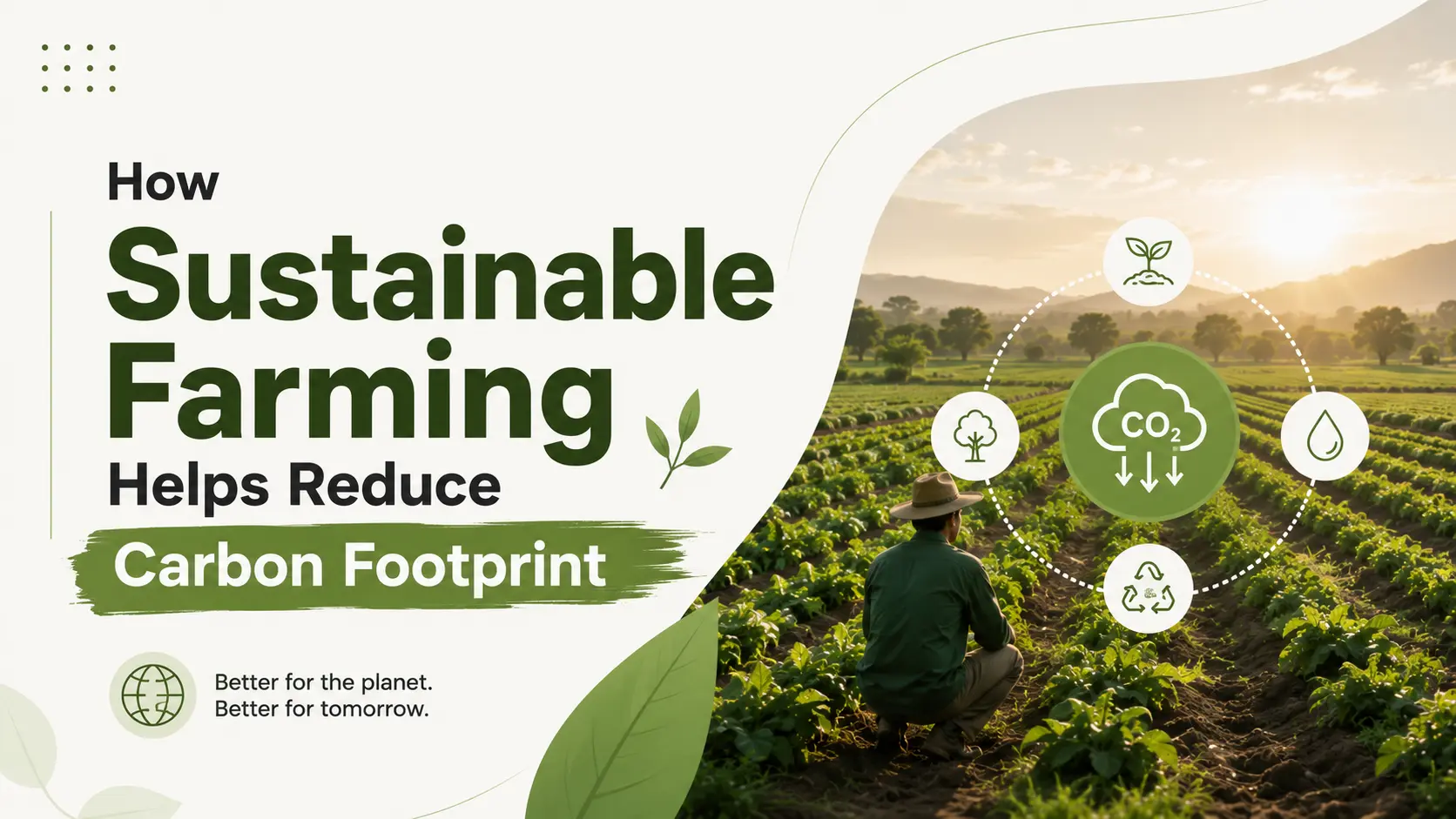
How Sustainable Farming Helps Reduce Carbon Footprint
The relationship between sustainable farming and carbon reduction is not based on one dramatic change.
It is the result of many small improvements working together.
1. Healthier Soil Can Store More Carbon
Healthy soil is one of nature’s most valuable assets.
Well-managed soil contains organic matter that helps support microbial activity, water retention, and nutrient cycling.
When soil health improves, it can contribute to the natural storage of carbon within agricultural ecosystems.
2. Reduced Dependence on Resource-Intensive Practices
Many sustainable farming approaches aim to optimize resource use.
This includes:
- Efficient irrigation
- Better nutrient management
- Precision farming techniques
- Reduced waste
The objective is not necessarily to use less of everything.
It is to use resources more intelligently.
Efficiency often translates into a lower environmental footprint over time.
3. Tree-Based Agricultural Systems Support Ecosystem Health
Not all farms look the same.
Permanent crops such as orchards introduce a different dynamic into agricultural landscapes.
Trees provide:
- Shade
- Habitat support
- Root stability
- Long-term ecosystem benefits
4. Water-Efficient Farming Reduces Environmental Pressure
Water is one of agriculture’s most important resources.
Sustainable farming practices increasingly focus on:
- Efficient irrigation systems
- Moisture conservation
- Improved water management
In regions where water availability is becoming more important, efficiency matters enormously.
5. Better Land Management Creates Long-Term Resilience
Perhaps the greatest environmental advantage of sustainable farming is resilience.
Healthy farms are not built season by season.
They are built decade by decade.
Practices that support:
- Soil quality
- Biodiversity
- Tree health
- Resource efficiency
often create agricultural systems that are more capable of adapting to future challenges.
And resilient systems are generally more sustainable systems.
The Role of Trees, Orchards, and Permanent Crops
There is something unique about tree-based agriculture.
Unlike seasonal crops that are replanted regularly, orchards develop over many years.
A mango orchard, for example, is not just a collection of trees.
It is an evolving ecosystem.
Trees interact with:
- Soil
- Water
- Microorganisms
- Local biodiversity
Over time, these systems can create environmental benefits that extend beyond simple agricultural production.
This is one reason why orchard-based farming continues to attract interest among people who care about both land stewardship and sustainable agriculture.
Why Soil Matters More Than Most People Think
Most people never think about soil.
They notice trees.
They notice crops.
But the foundation beneath everything often goes unnoticed.
Healthy soil helps support:
- Water retention
- Nutrient availability
- Plant growth
- Ecosystem stability
When soil is treated as a long-term asset rather than a disposable resource, farming outcomes often improve.
This principle sits at the core of sustainable agriculture.
Good farming starts below the surface.
Water Efficiency and Environmental Impact
Climate discussions often focus heavily on emissions.
Water deserves equal attention.
Agriculture relies on water. The challenge is ensuring it is used responsibly.
Modern sustainable farming systems increasingly prioritize:
- Precision irrigation
- Water monitoring
- Reduced runoff
- Moisture conservation
These improvements help create farming systems that are both productive and environmentally conscious.
The future of farming will likely depend as much on water stewardship as it does on any other resource.
Sustainable Farming Beyond Carbon
Reducing carbon footprint is important.
But sustainable farming offers benefits that extend far beyond emissions.
It also supports:
Healthier Ecosystems
Balanced agricultural landscapes support biodiversity and ecological stability.
Better Resource Management
Efficient use of land and water improves long-term sustainability.
Long-Term Productivity
Protecting natural resources helps maintain agricultural viability over time.
Responsible Land Stewardship
Sustainable farming encourages a long-term relationship with the land.
In many ways, these broader benefits are just as important as carbon reduction itself.
Why Consumers and Investors Are Paying Attention
A noticeable shift is happening.
People increasingly want to understand where their food comes from, how land is managed, and whether agricultural systems are designed responsibly.
This growing awareness is influencing:
- Consumer preferences
- Agricultural innovation
- Land management approaches
The conversation is no longer only about production.
It is also about stewardship.
And sustainable farming sits at the center of that evolution.
The Future of Farming Is Smarter, Not Bigger
For decades, agricultural progress was often measured by scale.
Today, it is increasingly measured by efficiency.
The future may belong not to the biggest farms, but to the smartest ones.
Systems that:
- Use resources efficiently
- Support long-term land health
- Improve productivity responsibly
- Balance economic and environmental considerations
are likely to shape the next chapter of agriculture.
This is one reason why professionally managed agricultural ecosystems are attracting attention.
The lesson is not that farming must become more industrial.
It is that farming can become more intentional.
Key Takeaways
FAQs
Sustainable farming refers to agricultural practices that support long-term productivity while protecting natural resources such as soil, water, and ecosystems.
Sustainable farming can support carbon reduction through healthier soil management, efficient resource use, and long-term ecosystem stewardship.
Healthy soil supports plant growth, water retention, nutrient cycling, and overall ecosystem resilience.
Orchards can contribute to sustainable agricultural landscapes when managed responsibly with long-term land stewardship practices.
Efficient water use helps conserve resources, reduce waste, and support long-term agricultural sustainability.