


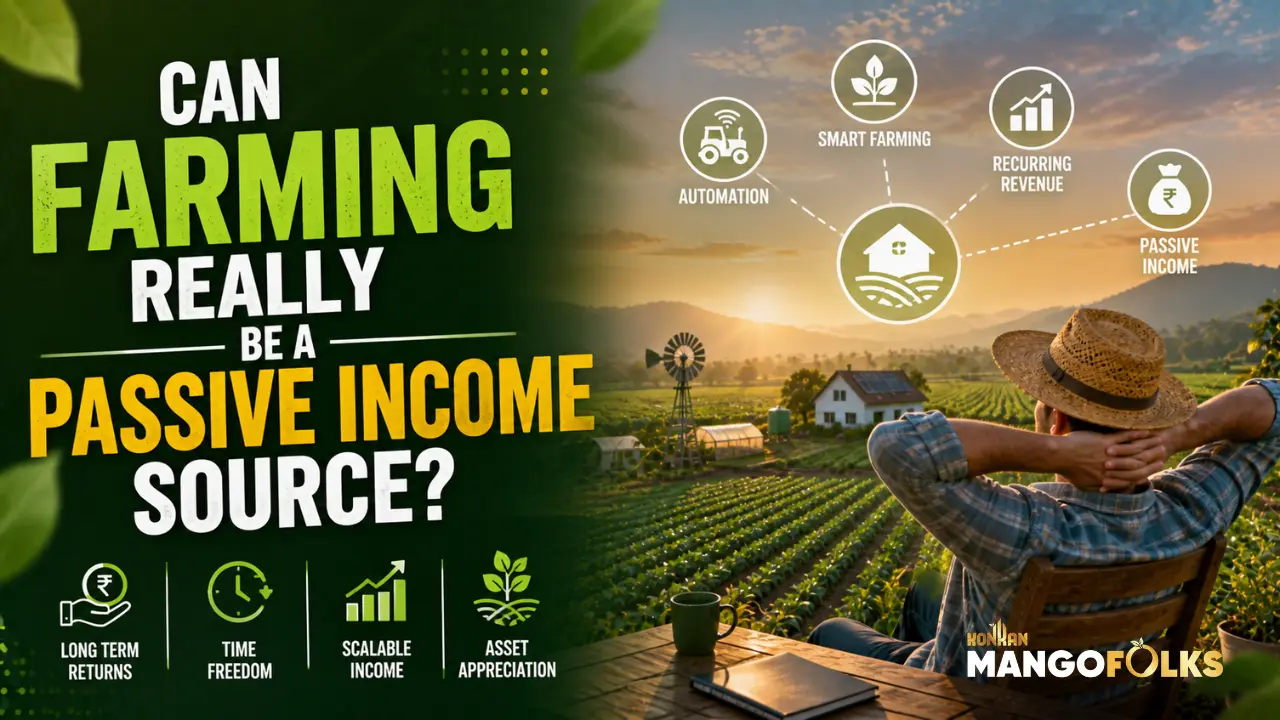
The Promise Everyone Is Hearing
There’s a certain kind of promise that sounds just believable enough to hook you.
“Earn passive income from farming.”
Income that grows from land. Returns that follow seasons instead of screens. Wealth that isn’t tied to volatility charts or quarterly earnings.
And yet, something about it makes you pause.
Because deep down, you know what farming looks like.
You’ve seen it.
You’ve heard stories.
So which one is true?
Is farming actually a passive income source in India…
or just another idea that sounds better than it works?
Why Farming Was Never Meant to Be Passive
For most of human history, farming has demanded one thing above all else:
Presence.
Not capital. Not strategy. Not scale.
Presence.
You had to be there—to read the soil, to watch the sky, to respond when something changed. Crops don’t wait. Weather doesn’t negotiate. Timing isn’t flexible.
That’s why farming was never treated as an “investment class.” It was a livelihood. A full-time commitment. Something you lived inside, not something you outsourced.
Even today, traditional farming in India still operates this way in many regions.
Which makes the idea of passive income from agriculture in India feel… contradictory.
Because nothing about farming is naturally passive.
So… Can It Actually Work Today?
Here’s the honest answer:
Yes. But not in the way most people imagine.
What’s changed is everything around farming.
The systems.
The structure.
The people managing it.
And that shift matters more than most people realize.
The Truth: Farming Isn’t Passive—Systems Make It So
If you strip away the marketing language, the only way farming becomes “passive” is through one thing:
Separation of ownership and operation.
You own the asset.
Someone else runs the system.
That’s it.
No magic. No shortcuts.
Think about it this way.
Rental income isn’t passive because buildings maintain themselves.
It’s passive because someone else handles the tenants, the maintenance, the problems.
Farming works the same way.
The land still needs:
- Irrigation
- Pruning
- Pest control
- Harvesting
- Market linkage
The difference is:
👉 You are not the one doing it.
And when that separation is clean, structured, and transparent…
that’s when farmland investment in India begins to behave like a passive asset.
Where Most People Get It Completely Wrong
The biggest misconception is this:
“If I buy farmland, I’ll earn passive income.”
No.
You’ve just bought responsibility.
Without systems in place, farmland becomes:
- Underutilized
- Poorly managed
- Financially stagnant
And in some cases, it becomes exactly what you were trying to avoid:
👉 A time-consuming asset with uncertain returns.
Another common mistake?
Chasing the idea of passive income instead of understanding the mechanism behind it.
Passive income is not about doing nothing.
It’s about delegating complexity to something reliable.
And most farmland investments fail not because farming doesn’t work—but because the structure around it doesn’t.
What Makes Farming “Feel” Passive
There’s a moment—if everything is set up right—when farming starts to feel different.
You’re not checking daily updates.
You’re not worrying about operational decisions.
You’re not reacting to every small fluctuation.
Instead, you’re observing.
Receiving updates.
Seeing yield reports.
Understanding performance.
And the income?
It comes seasonally. Predictably. Quietly.
That’s when it begins to resemble what we call passive income from agriculture.
Not because nothing is happening.
But because everything is happening without needing you.
The Economics Nobody Explains Clearly
Let’s talk numbers—but without reducing everything to a spreadsheet.
Take a mango orchard.
Not as an abstract concept, but as a real, working system.
In its early years, it gives you nothing. You invest, you wait, you build.
Around year 4 or 5, it begins to respond. Not dramatically—but noticeably.
And then, slowly, it stabilizes.
By year 8 or beyond, a well-managed orchard can generate meaningful income—often in the range of ₹3–5 lakh annually per acre, depending on yield quality, pricing, and management efficiency.
But here’s the part most people miss:
👉 The real return is not just the annual income.
It’s the combination of:
- Recurring agricultural yield
- Land appreciation
- Asset maturity
This is why agriculture investment returns in India feel different.
They don’t spike.
They accumulate.
A Reality Check Most Blogs Skip
Let’s not romanticize this.
Even the best-managed farming systems are not risk-free.
- Weather still matters
- Market prices still fluctuate
- Biological systems are never perfectly predictable
So if someone is selling you “guaranteed passive income from farming,”
they are not describing farming.
They are describing a narrative.
The more honest version is this:
👉 Farming can become a low-involvement, system-driven income stream
👉 But only when the structure supporting it is strong
Where This Is Quietly Becoming Real
What’s interesting is not that farming can be passive.
It’s that it’s slowly becoming practically accessible.
Earlier, if you wanted to benefit from agriculture, you had to:
- Be physically present
- Understand farming deeply
- Manage everything yourself
Now, that barrier is shifting.
Structured models are emerging where:
- Land is legally verified
- Farming is professionally managed
- Yield is tracked
- Revenue is shared
Not as an abstraction—but as a system.
And this is where platforms like Mangofolks by Konkan Estate come into the picture—not as a shortcut, but as an example of how the model is evolving.
They focus on managed mango orchards, where:
- Farming is done using scientific methods like UHDP
- Operations are handled by experienced teams
- Investors participate in the outcome, not the process
Which aligns closely with what actually makes passive income from farmland in India possible:
👉 Not the land itself
👉 But the system built around it
Key Takeaways
- Farming is not inherently passive
- It becomes passive only through structured management
- Ownership and operation must be clearly separated
- Returns are long-term and compounding, not immediate
- The right system determines whether it works—or doesn’t
Yes—but typically through structured, professionally managed farming models where operations, cultivation, and maintenance are handled on your behalf.
It can be, provided the land has a clear legal title and the farming operations are systematically and professionally managed.
In most cases, it takes around 5–8 years to generate stable income, depending on the crop type, farming method, and management quality.
Perennial crops like mango—especially under UHDP (Ultra High Density Plantation) systems—are preferred for consistent, long-term returns.
The primary risks include weather variability, fluctuating market prices, and the quality of farm management.
Closing Thought
The idea of passive income from farming isn’t wrong.
It’s just misunderstood.
Because the land doesn’t do less work.
The system does more of it—for you.
And once that balance is right, something shifts.
You’re no longer trying to “manage farming.”
You’re simply participating in something that grows—
with or without your daily involvement.
And that’s as close as farming gets to passive.