


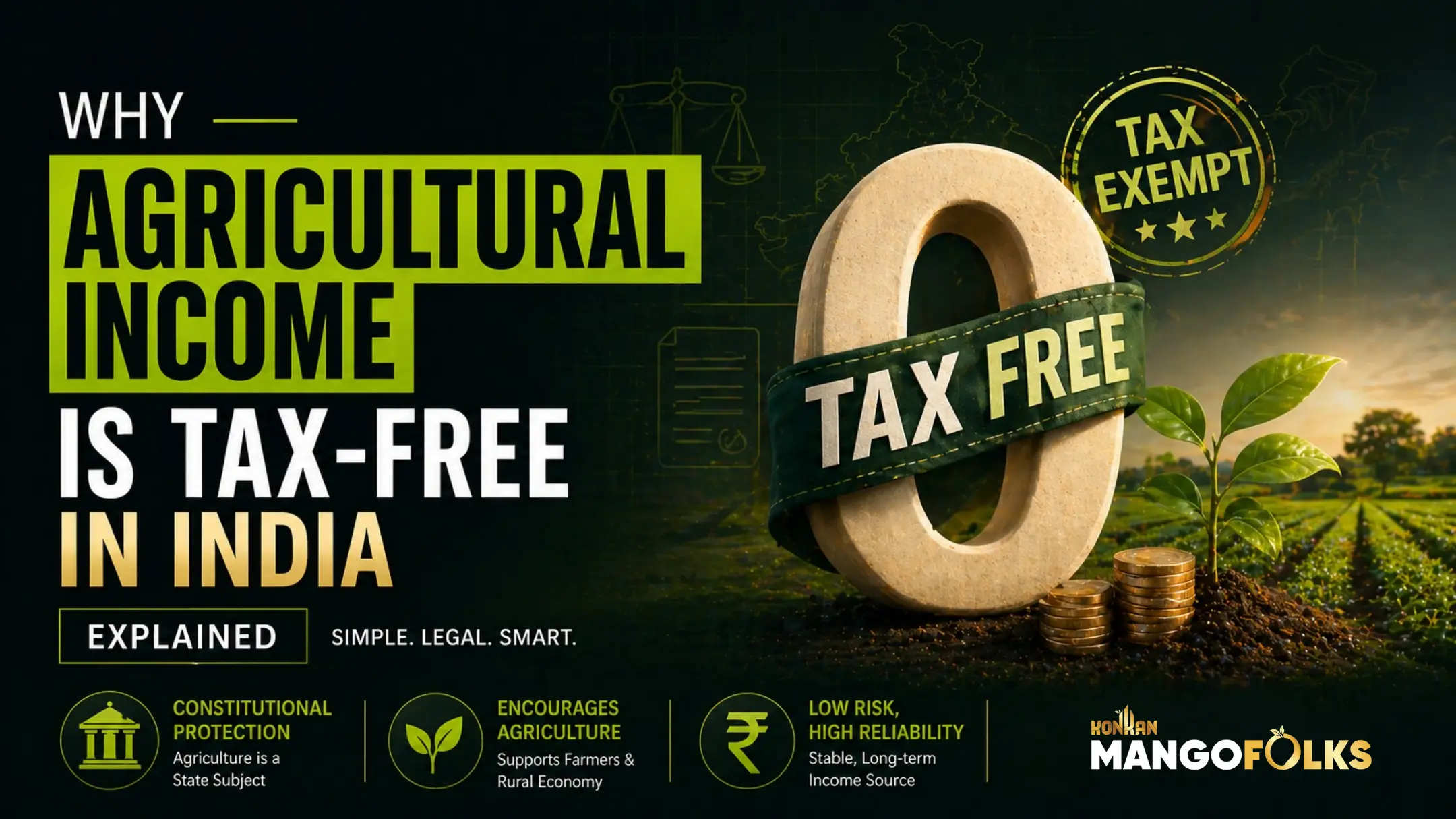
The Question Most Investors Eventually Ask
At some point, almost every investor stumbles upon this:
“Is agricultural income really tax-free in India?”
And more importantly:
“If it is… why?”
Because on the surface, it feels almost too good to be true. Salaries are taxed. Businesses are taxed. Capital gains are taxed. Yet, agricultural income in India remains exempt from income tax.
This isn’t a loophole.
It’s not a grey area either.
It’s a deliberate policy decision rooted in history, economics, and federal structure, and once you understand it, it changes how you look at farmland investment in India altogether.
What is Agricultural Income (Legally Speaking)?
Before understanding why it’s tax-free, you need to understand what qualifies as “agricultural income” under Indian law.
According to the Income Tax Act, agricultural income includes:
- Income from cultivating land
- Revenue from sale of agricultural produce
- Income from processing agricultural produce (as long as it doesn’t change the nature of the produce)
- Rent or revenue from land used for agricultural purposes
In simpler terms, if the income is directly derived from land and farming activity, it falls under agricultural income exemption India.
But this definition is stricter than most people assume, and we’ll get to that.
Why Agricultural Income is Tax-Free in India
Here’s where things get interesting.
The tax exemption isn’t random. It comes from three core reasons:
1. Constitutional Structure (The Real Reason)
Agriculture is a state subject under the Indian Constitution.
This means:
- The central government cannot tax agricultural income
- Only state governments have jurisdiction over it
So when we say agricultural income is tax-free, what we really mean is:
👉 It is exempt from central income tax
2. Protection of Farmers
Historically, agriculture has been:
- Low-margin
- High-risk (monsoons, pests, market volatility)
Taxing this income would:
- Increase financial pressure on farmers
- Discourage agricultural activity
So the exemption acts as a protective economic buffer.
3. Encouraging Agricultural Activity
India still depends heavily on agriculture.
Tax exemption:
- Encourages land use for farming
- Promotes food security
- Supports rural economies
Which is why even today, agricultural income tax rules in India remain favorable.
The Hidden Clause Most People Miss: Partial Integration
Here’s where most explanations online stop, and where real understanding begins.
If your:
- Agricultural income > ₹5,000
AND - Non-agricultural income > basic exemption limit
Then the government uses something called:
Partial Integration of Income
What does that mean?
👉 Your agricultural income is NOT taxed
👉 But it is used to determine your tax slab
Simple Example
- Agricultural income: ₹5,00,000
- Salary: ₹8,00,000
Your tax slab is calculated as if your income is ₹13,00,000, but you only pay tax on ₹8,00,000.
This ensures:
- The exemption is preserved
- But high-income individuals don’t misuse it to fall into lower tax brackets
What Qualifies as Agricultural Income, and What Doesn’t
This is where people often get it wrong.
✅ Qualifies as Agricultural Income
- Selling crops (mangoes, rice, wheat, etc.)
- Income from orchards
- Cultivation-based revenue
- Basic processing (like drying, grading)
❌ Does NOT Qualify
- Running a farmhouse as a resort
- Trading agricultural produce (without growing it)
- Commercial processing (like making packaged goods)
- Rental income from non-agricultural use
This distinction matters because misclassification can:
- Trigger scrutiny
- Lead to penalties
How This Impacts Farmland Investment in India
Now connect the dots.
When structured correctly, farmland investment in India offers:
1. Tax-Free Income Stream
Income generated from actual agricultural activity:
- Falls under tax-free agricultural income India
- Improves net returns significantly
2. Dual Benefit: Yield + Appreciation
Unlike traditional assets:
- You earn from produce (cash flow)
- And from land appreciation (capital growth)
3. Lower Tax Burden Overall
Compared to:
- Rental income (taxable)
- Stock gains (taxable)
- Business profits (taxable)
Agricultural income offers a rare tax-efficient asset class
Common Misconceptions (and Costly Mistakes)
Let’s clear a few myths that float around:
❌ “All farmland income is tax-free”
No. Only income from actual agricultural activity qualifies.
❌ “You can use this to avoid tax completely”
Partial integration ensures that tax slab manipulation is limited.
❌ “Owning land automatically gives tax benefits”
Ownership ≠ agricultural income
You need active or managed cultivation
❌ “You don’t need documentation”
Wrong. You should maintain:
- Land ownership records
- Crop details
- Sales proof
A Practical Framework: How to Stay Compliant
If you’re considering agricultural income seriously, follow this:
Step 1: Ensure Land is Legally Agricultural
- Check zoning
- Verify land use classification
Step 2: Establish Genuine Agricultural Activity
- Crop cultivation
- Plantation
- Orchard management
Step 3: Maintain Records
- Produce quantity
- Sales receipts
- Operational expenses
Step 4: Understand State Laws
Some states:
- Restrict non-farmers from buying land
- Have ownership conditions
Step 5: Plan Tax Reporting Correctly
Even if exempt:
- Agricultural income must be reported in the ITR
- Especially for partial integration cases
Where This Becomes Interesting for Modern Investors
For a long time, agriculture was seen as:
- Labor-intensive
- Unstructured
- Difficult to manage
But that’s changing.
Structured models today allow:
- Professional farm management
- Scientific cultivation methods
- Transparent reporting
Which means you can:
- Own land
- Generate passive income from agriculture in India
- Without being a full-time farmer
Key Takeaways
- Agricultural income in India is tax-free due to constitutional and economic reasons
- It applies only to genuine agricultural activity
- Partial integration ensures fair tax treatment
- Farmland can offer tax-efficient income + appreciation
- Compliance and structure matter more than ownership
Agriculture is a state subject, so the central government does not tax agricultural income. This policy also supports farmers and rural economies.
No. Only income derived from actual agricultural activities qualifies. Indirect or non-agricultural uses are not exempt.
Partial integration is a method where agricultural income is considered to determine your tax slab, even though it is not taxed directly.
Yes. Even though it is exempt, it must be declared in your income tax return, especially if it affects your tax slab.
Yes, depending on state laws. However, the income must come from genuine agricultural activity, not indirect land usage.
Closing Thought
The real advantage of agricultural income isn’t just that it’s tax-free.
It’s that it forces you to think differently about what income actually is.
Not just numbers on a statement,
but something tied to land, cycles, seasons, and long-term value.
And once you start seeing it that way,
you don’t just ask “Is it tax-free?”
You start asking:
“Am I investing in something fundamentally stronger?”